
Most of what keeps you safe on a bicycle is the same everywhere: be visible, be predictable, look before you move. The law is not the same everywhere, though, and Czech traffic law has several rules that differ from what North American and Australian riders are used to.
This guide sets out what the Czech road traffic act, Act No. 361/2000, says about cycling, and then what the roads are like on our routes. It is a plain-language summary for visitors and not legal advice. Laws are amended, so check the current rules with the Czech transport ministry or the BESIP road-safety agency before you travel.
A Cyclist Is a Driver
The starting point is a definition. Czech law defines a driver as anyone who drives a motor or a non-motor vehicle, and it names the bicycle as a non-motor vehicle. So the general duties of drivers, on alcohol, on phones, on obeying signs and signals, apply to you on a bike exactly as they apply to the person in the car behind you.
Traffic keeps to the right, and the act tells cyclists to ride at the right-hand edge of the road. You may use the right shoulder if that does not endanger or obstruct pedestrians.
Single File, Always
This is the rule that surprises club riders. The act says, in one short sentence, that cyclists may ride only in single file. There is no exception for quiet roads or for groups. Riding two abreast to talk is against the law on a Czech road.
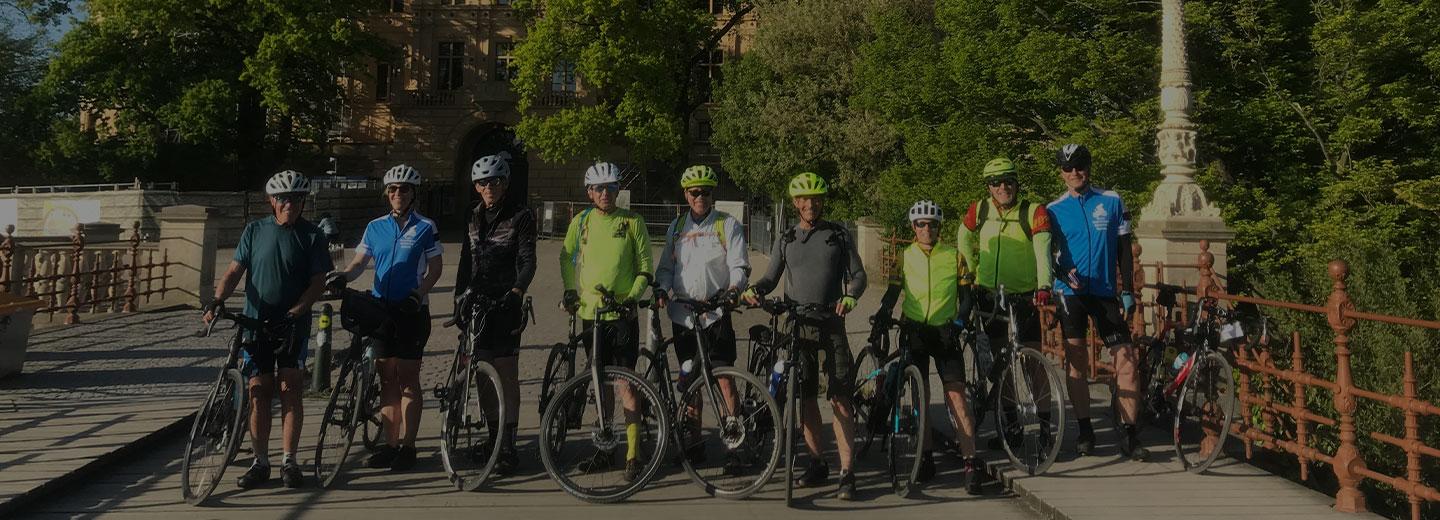
On tour, that shapes how a group moves. We ride in a line with gaps that let a car slot in, and we save the conversation for the snack stops. It is also simply good manners on the narrow country roads we use, where the driver behind is likely to be a local on the way home.
Cycle Lanes and Cycle Paths Are Compulsory
Where a cycle lane, a reserved cycle lane or a cycle path has been provided, the law obliges you to use it in that place and direction. The only exception written into the act is where using it would endanger safety or the flow of traffic.
Many Czech paths are shared with pedestrians. On a shared path you must not endanger people walking. Where the path is divided into a pedestrian side and a cycling side, you ride only on the cycling side, and may cross to the other only to pass, turn or join the path, again without endangering anyone on foot. A bell and a slow pass are the practical answer.
Helmets: Compulsory Under 18
Anyone under 18 who is riding a bicycle, or being carried on one, must wear an approved helmet, properly fastened. For adults the law leaves it to you.
We do not. The waiver every rider signs before a tour includes an agreement to wear an approved helmet at all times when riding during the tour. Our rental bikes do not come with one, so bring your own from home, where you can check the fit.
One more age rule matters if you are traveling as a family outside a tour: a child under 10 may ride on a road only under the supervision of someone over 15. That does not apply on a sidewalk, a cycle path or in a residential or pedestrian zone.
Lights and Equipment
In reduced visibility you must ride with a white light shining forward and a red rear light, which may be steady or flashing. If the road is well and continuously lit, a flashing white front light is acceptable instead of a steady one. Reduced visibility is not only night: dusk, fog and heavy rain all count.
BESIP, the Czech road-safety agency, lists the equipment every bicycle must carry: two independent working brakes, a white reflector at the front, a red reflector at the rear, orange reflectors on both sides of the pedals and at least one orange reflector in the spokes on each side of each wheel. The front and wheel reflectors may be replaced by reflective elements. If you bring your own road bike with clipless pedals and no reflectors, be aware of that list. Our rides are planned for daylight, but a small pair of lights weighs almost nothing and covers you for a late finish or a storm.
Alcohol: No Permitted Level
This is the second rule that catches visitors, and in a country famous for its beer it deserves to be stated carefully. The act says a driver must not consume alcohol while driving, and must not drive immediately after drinking or at any time afterward when he or she could still be under the influence. It gives no permitted level for that rule. Because a cyclist is a driver, it applies on a bicycle.
Our itineraries include a tour of the Budvar brewery in Ceske Budejovice and evenings near the old Regent brewery in Trebon. On Vienna to Prague and Munich to Prague the brewery tour follows the day's ride. On Jewels of the Czech Republic it comes before the 35 km (22 mile) ride to Cesky Krumlov, so that morning is for looking, and the tasting can wait for the evening. A beer with lunch and 30 km still to ride is not a gray area under Czech law.
Phones, Hands and Other Prohibitions
A driver may not hold a telephone or other communication or recording device in the hand while riding. Mount the phone on the handlebar if you use it for navigation, and stop to take a call or a photograph.
The act lists several other things a cyclist must not do:
- Ride without holding the handlebars.
- Hold on to another vehicle.
- Lead a second bicycle, a dog or another animal while riding.
- Carry objects that make the bicycle harder to control or endanger others.
- Ride with feet off the pedals.
- Smoke while cycling.
One rule works in your favor. When vehicles are moving slowly or standing in a line at the right-hand edge of the road, a cyclist going the same way may pass them on the right if there is enough room, taking extra care. That does not apply when a vehicle is signaling a right turn.
What Drivers Owe You
The act puts a number on overtaking. A motor vehicle passing a cyclist must keep a safe lateral gap, defined as at least 1.5 meters between the nearest edges of the vehicle and the bicycle or rider. Where the speed limit is 30 km/h or less, the minimum is 1 meter.
Cycling is a normal part of traffic here: the national tourist board describes a dense network of well-marked cycling routes, and four EuroVelo routes cross the country. Do not assume the gap, though. Hold a steady, predictable line and signal clearly before you move out.
What the Roads Are Like on Our Routes
Our tour pages describe the Czech riding as mostly small, quiet and picturesque roads with little car traffic, together with bike paths. Surfaces are for the most part very good. In southern Bohemia there are a few sections with rougher, patched tarmac, and on the Berlin to Krakow tour there are a few short sections of firmly packed dirt. Our Munich to Prague page suggests a road or touring bike with 23 to 28 mm tires, and that is a sound choice for all of these routes.
Two hazards are worth naming. Cobblestones in historic town centers are slippery when wet, so walk if in doubt. And we do not ride in Prague traffic at all: each tour that visits the capital uses a bus between the city and the countryside.
What the Support Van Changes
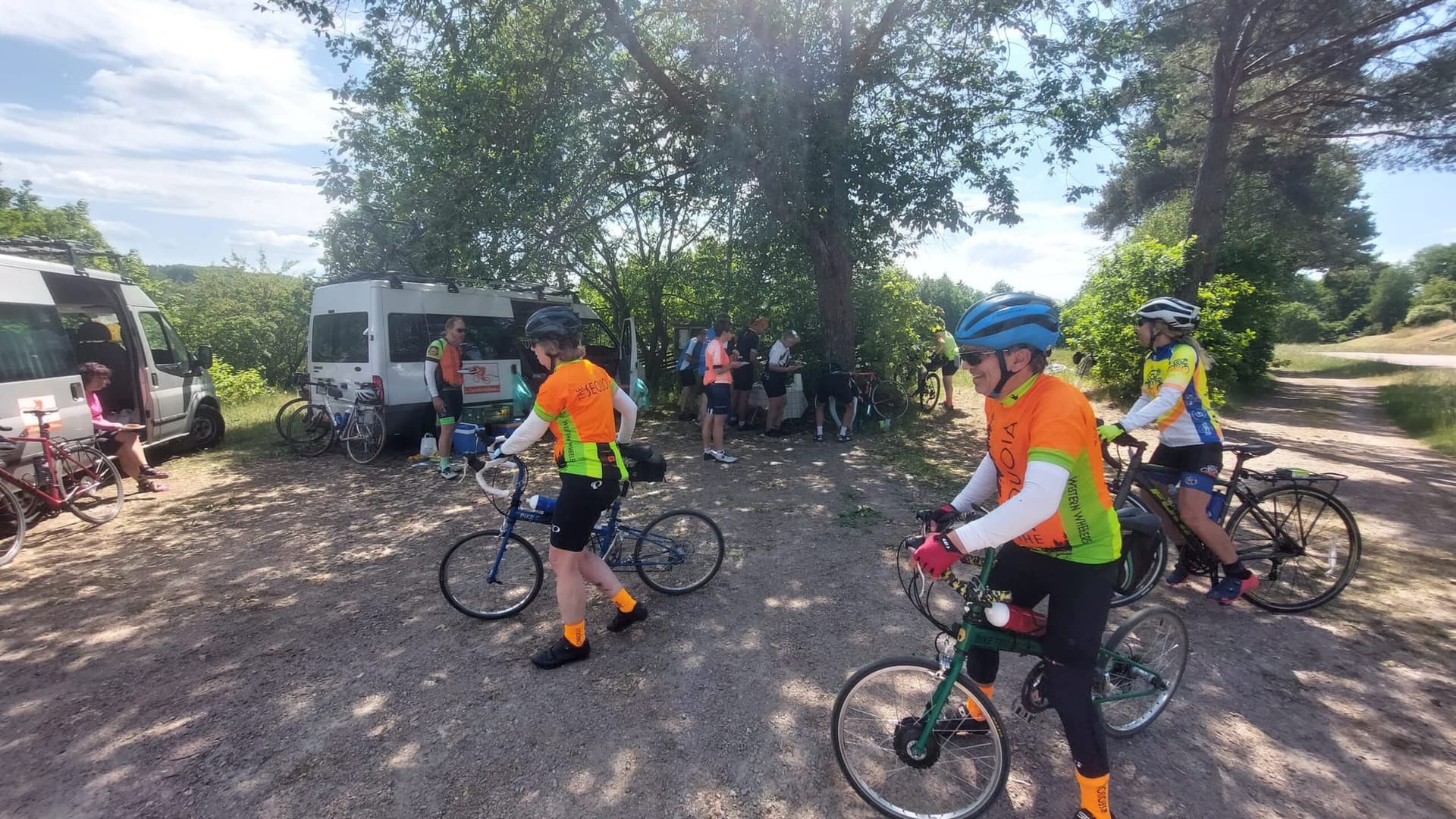
On a supported tour several of these risks shrink. You are not carrying luggage, so the bike handles normally. A ride leader is on the route with the group. The van carries tools, spares, water and snacks, and mechanical support is included, so a puncture on a narrow road is dealt with quickly.
Navigation is taken care of as well. Our tours come with a detailed itinerary for each riding day, with GPS navigation on most of them, and with emergency phone numbers for the tour staff, so a rider who drops off the back of the group is not left guessing at a junction. That matters for safety more than it sounds: a rider who is reading a map is not watching the road.
The van also removes the pressure that causes bad decisions. If you are tired on a long day, if the rain arrives, if the light is going, you can get in.
In an emergency the number is 112, the European emergency number, which is free and works everywhere in the European Union. On tour, tell your guide first if you can: the guide knows where you are and speaks the language.
Read the current rules at the source before you go, pack lights and your own helmet, and check that your travel insurance covers a multi-day cycling tour. Nothing here replaces the text of the law or the advice of the authorities, and the summary above reflects the act as we read it in October 2026.
See the Jewels of the Czech Republic Tour