
Finland is an easy country to ride in and a slightly unfamiliar one to ride correctly in. The roads our tour uses are quiet, the last day into Helsinki is mostly on bike paths, and the rules are few. But several of them are stricter than a visiting road cyclist expects, particularly on where you must ride and how a group arranges itself, and one of them, the right-hand rule at junctions, is easy to forget if you did not grow up with it.
What follows is a plain summary drawn from Liikenneturva, the Finnish Road Safety Council, and from the Emergency Response Center Agency. It is not legal advice. The Road Traffic Act is amended from time to time, so check Liikenneturva's current guidance before you travel.
The Rules in Brief
- Ride on the right. If there is a cycle path for your direction of travel, you must use it.
- Ride one behind the other, not side by side; that is the Road Safety Council's guidance.
- A bell or other audible warning device is mandatory, and so are reflectors.
- Lights are required after dark and in poor visibility: white or light yellow at the front, red at the rear.
- The Road Traffic Act says cyclists and their passengers are generally required to wear a helmet.
- Give way to traffic from the right at junctions unless a sign says otherwise.
- The emergency number is 112.
Where You Must Ride
Liikenneturva states the rule without qualification: in Finland cyclists must use the cycle path if there is one for the direction in which they are traveling. This is the point on which Finland differs most from the habits of club riders elsewhere. A fast group on a road bike does not get to choose the roadway because the path is slower.
Where there is no cycle path or cycle lane, the rule is to ride on the verge on the right-hand side of the road, or on the right side of the road itself.
Children under 12 may ride on the sidewalk, provided they leave pedestrians free passage. Everyone else belongs on the path, the lane or the road.
Finland also has cycle streets. Cars are allowed on them, Liikenneturva explains, but cyclists must be given unobstructed access. If you find yourself on one in a town, you ride as normal and the drivers adapt to you.
Single File
The second point that surprises visitors is formation. Liikenneturva's guidance is that cyclists ride one behind the other, not side by side, and that on the road they follow the same rules as motorists.
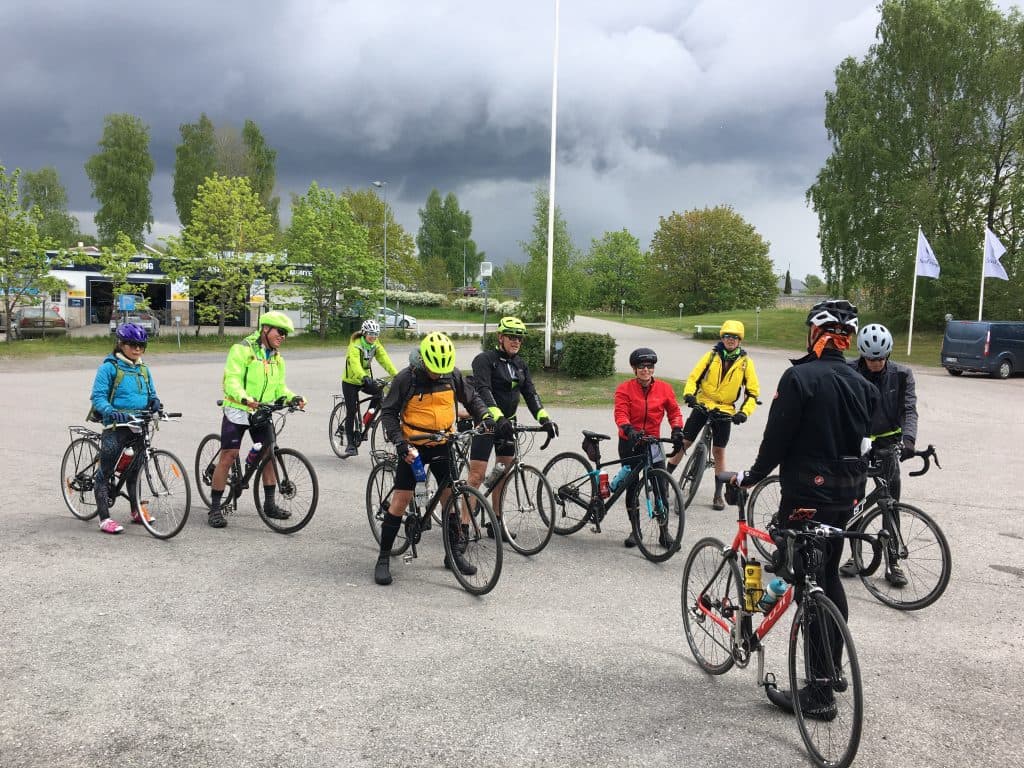
For a tour group this simply means the conversation waits for the snack stop. Hold a single line on the road and leave gaps so that a driver can pass a few bikes at a time. It is the council's guidance, it is safer, and on the wooded roads between Salo and Ekenäs it costs nothing.
What the Bike Must Have
Liikenneturva's advice to visitors is to check that the cycle carries its mandatory equipment before setting off: reflectors, a bell and lights. In detail:
- An audible warning device, such as a bell
- A white reflector at the front, a red reflector at the back, and white or brown-yellow reflectors to the side, or reflective tires or stickers
- When cycling after dark or when visibility is poor, a white or light yellow front light and a red rear light
Riders bringing a race bike from home should note the first two. A bike with no bell and no reflectors does not meet the Finnish equipment rules, in daylight or otherwise. A small bell and a set of clip-on reflectors weigh almost nothing.
Lights are the item most likely to be forgotten on a summer tour, because in June the longest day in southern Finland is nearly 19 hours and it is hard to imagine needing them. The rule covers poor visibility as well as darkness, though, and a heavy summer downpour can bring that on in the middle of the afternoon. Carry a set.
Helmets
The legal position is unusual and worth stating exactly. Section 92 of the Road Traffic Act, as Liikenneturva puts it, says that cyclists and bicycle passengers are generally required to wear a protective helmet. The wording covers cyclists in general and is not limited to children, unlike Sweden's under-15 rule. Helmets must be CE approved, and the European standard for cycle helmets is EN 1078.
In practice the decision is already made for our riders. A helmet is not supplied with our rental bikes, so bring your own from home, where you can be sure of the fit.
Alcohol and Phones
Liikenneturva's wording on alcohol is careful: in Finland cycling drunk is an offense if the cyclist causes danger to other road users. That is not a license to ride after a long lunch. It means the law looks at whether you were a danger, and a rider who has been drinking usually is one. The sensible rule is that drinks come after the ride.
On phones, the council's advice is equally short: if you need to use your phone, stop at a safe place first. With GPS files and cue sheets for every riding day, there is no reason to be reading a screen in motion.
Who Gives Way
Liikenneturva sets out the basic rule: at an intersection, give way to vehicles approaching from the right unless there is a road sign indicating otherwise. It applies to you on a bicycle exactly as it applies to a driver, and it applies on small residential streets and country junctions where nothing is painted on the road.
The second habit to learn is signaling. Cyclists have a duty to indicate when turning and to give audible warnings, which is what the bell is for. On shared paths, Liikenneturva asks cyclists to pay special attention to pedestrians and give them safe space. Ring early, slow down, and pass wide.
- At an unmarked junction, look right first and be ready to stop.
- Signal every turn with an arm, in good time.
- Use the bell before passing a pedestrian or another cyclist, not as you pass.
- Stop for stop signs and red lights; the same rules apply to you as to motorists.
Road Conditions on Our Finnish Days
Rules are half of safety. The road is the other half, and our itinerary is written with that in mind.
On Åland, Days 11 and 12 are short loops from Mariehamn of 55 km (35 miles) and 30 km (20 miles). Visit Åland, the official tourist board, describes the islands' roads as being of a high standard, with many bicycle paths.
On the mainland, both riding days begin with a transfer. Day 13 starts with a shuttle in the van or a train from Turku to Salo before the ride to Ekenäs. Day 14 starts with a short shuttle specifically to avoid riding on the busy main road, which is the only road from Ekenäs toward the capital. Once the riding starts that day, the route is mostly on bike paths or small county roads all the way into Helsinki.
That is the principle behind all our routes: small, quiet roads with as little car traffic as possible, and a vehicle transfer where no such road exists. With the exception of a few sections, the roads and paths are paved.
Wildlife and Weather
Liikenneturva's advice to road users in Finland is to take wildlife warning signs seriously. Our own itinerary notes that on the wooded day from Salo to Ekenäs the group may, with luck, see a moose. Luck is the right word when the animal is at a distance. If one is on or near the road, stop well back and wait.
The council's other piece of advice is about weather: stay on top of the forecast, take warnings seriously, and postpone a journey if the weather gets rough. On a supported tour, postponing means a seat in the van, which is a much easier decision to make than it is alone.
In an Emergency: 112
Finland has one emergency number, 112, and the same number works in every EU country. The Emergency Response Center Agency says that it can be called free of charge from any phone, with no area code, and that it is for emergencies and urgent assistance from the authorities, or when you know or suspect that someone's life, health, property or the environment is in danger.
Two details matter to visitors. Operators are obliged to handle calls in Finnish and Swedish, with interpreter services for other languages, so speak slowly and start with where you are. And the agency publishes a free app, 112 Suomi, which relays your location to the emergency response center automatically when you call through it. It is worth installing before the trip.
Misuse of the number is a punishable offense. For a mechanical problem or a wrong turn, the call is to your guide, on the emergency phone numbers we give every rider.
What a Support Van Changes
The risks that matter most on a cycling trip are ordinary ones: riding tired, riding in bad weather because there seems to be no alternative, and being alone when something breaks. Our tours are built to remove those.
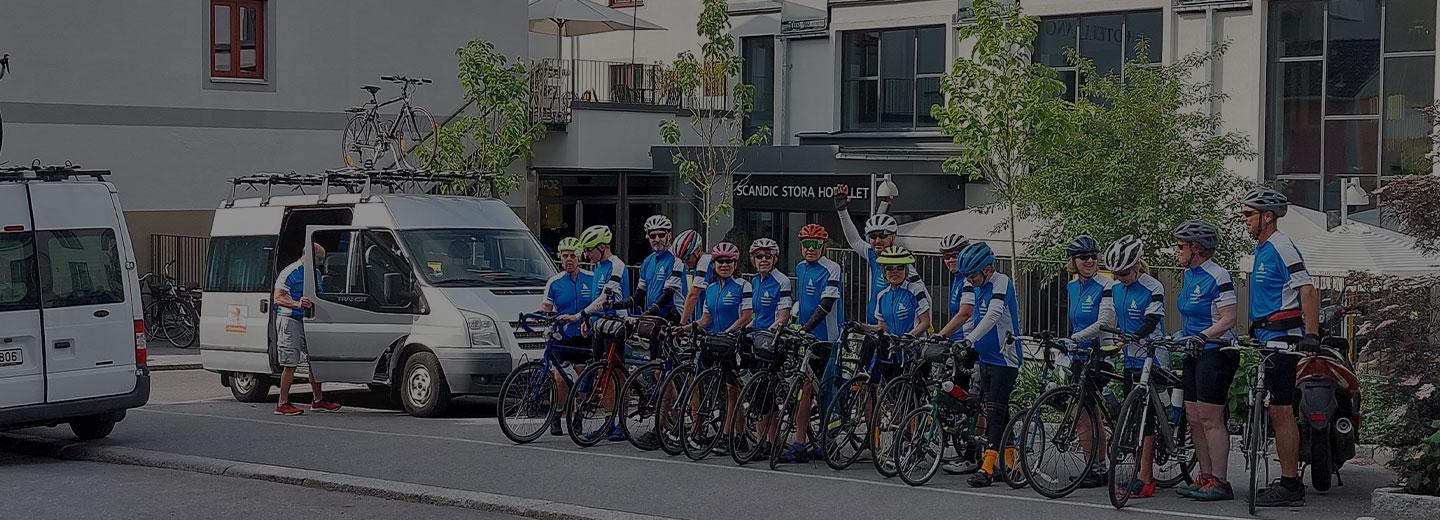
There is a tour guide and ride leader on the route. The van carries luggage, tools, spares, water and snacks, and it will give any rider a lift for part of a day or all of it, without notice and without explanation. On the Finnish section it also does the transfers that keep the group off the one road we do not want to ride.
Knowing the rules still matters, because you are the one on the bike. But the rider who knows a lift is available makes better decisions than the one who has to finish.
See the Copenhagen to Helsinki Tour