Poland has a real winter and a real summer, and the cycling season sits between them. For a visiting rider the practical season runs from late spring to early autumn, and within it the months differ more than a single average would suggest. Summer is the warmest time and also the wettest. The shoulder months are drier and cooler. The hills in the south get a good deal more rain than Krakow does.
Every figure in this article comes from the climate normals for 1991 to 2020 published by IMGW, Poland's national meteorological service. Unless we say otherwise they belong to the Krakow station, because Krakow is where our Berlin to Krakow tour finishes. They are thirty-year averages, not a forecast, and a single week can sit well to either side of them.
The Short Answer
May to September is the season. In those five months the average daily maximum in Krakow stays between 19.5°C and 25.3°C (67°F and 78°F). April and October are rideable for someone who dresses for it, with average highs of 15.1°C (59°F) and 14.0°C (57°F), but mornings are cold: the average minimum is 3.7°C (39°F) in April and 4.7°C (40°F) in October.
From November to March the average maximum does not get above 8.4°C (47°F), and the average minimum is below freezing from December through March. That is not touring weather.
Krakow by the Numbers
These are the IMGW averages for the riding months at Krakow: the average daily maximum, the average daily minimum and the average monthly precipitation.
- April: 15.1°C high (59°F), 3.7°C low (39°F), 46 mm of precipitation.
- May: 19.8°C high (68°F), 8.5°C low (47°F), 79 mm.
- June: 23.2°C high (74°F), 12.2°C low (54°F), 77 mm.
- July: 25.3°C high (78°F), 13.8°C low (57°F), 98 mm.
- August: 25.0°C high (77°F), 13.4°C low (56°F), 73 mm.
- September: 19.5°C high (67°F), 9.2°C low (49°F), 66 mm.
- October: 14.0°C high (57°F), 4.7°C low (40°F), 51 mm.
Two things stand out. The first is how moderate the summer is. A July afternoon that averages 25°C is warm riding, not punishing riding. The second is that the warm months are the wet ones. July is both the warmest month and the one with the most precipitation, and the annual total for Krakow is 673 mm.
Spring: April and May
April is early. The afternoons can be pleasant, but an average minimum of 3.7°C means a cold start, and you would want full-finger gloves and leg warmers for the first hour. It is the driest of the riding months on the Krakow figures, at 46 mm.
May is where the season properly begins. The average high climbs to almost 20°C and the lows to 8.5°C. It is also the month when the rain arrives: the average jumps from 46 mm in April to 79 mm in May, and IMGW counts an average of 10.3 days in May with at least 1 mm of precipitation. On average, five days in May reach 25°C (77°F) or more.
Early Summer: June
June gives the longest days of the year, since the summer solstice falls in the second half of the month. That is useful on a tour, because a late start or a long lunch does not put you under pressure at the other end of the day.
On the Krakow averages June is warm without being hot: a high of 23.2°C, a low of 12.2°C, and on average 11 days reaching 25°C or more. Days of 30°C (86°F) or more are uncommon, an average of 1.9 in the month. Rain is about the same as May, at 77 mm, falling on an average of 9.2 days.
High Summer: July and August
July and August are the warmest months, with average highs of 25.3°C and 25.0°C. About half the days in each month reach 25°C or more, 16.9 in July and 15.8 in August on average. Hot days in the full sense are fewer than riders from North America or Australia might expect: an average of four days in each month reach 30°C or more.
July is the wettest month of the year in Krakow, at 98 mm over an average of 11.1 days with at least 1 mm. August is noticeably drier, at 73 mm over 8.5 days. If you are choosing between the two for an independent trip and care about rain, the averages favor August.
Autumn: September and October
September is the quiet favorite. The average high is 19.5°C, almost identical to May, and the average low of 9.2°C is slightly milder than May's. Precipitation falls to 66 mm over an average of 8.6 days. Only three or four days in the month reach 25°C. The days are shortening, so there is less slack in the afternoon than in June.
October brings the season to an end. An average high of 14.0°C is still comfortable in the middle of the day, but the average low is 4.7°C. It suits a rider who is used to cool-weather riding at home and does not mind arm warmers until lunch.
How Many Wet Days to Expect
Monthly totals in millimeters are hard to picture. A more useful number for a rider is how many days in a month actually see rain. IMGW counts the days with at least 1 mm of precipitation, and at Krakow the averages for the riding months are close to one another.
- April: 8.2 days.
- May: 10.3 days.
- June: 9.2 days.
- July: 11.1 days.
- August: 8.5 days.
- September: 8.6 days.
- October: 8.3 days.
Put simply, in any month of the season roughly one day in three or four has measurable rain, and two days in three do not. July's higher total comes from a couple more wet days and from heavier falls, not from a month of gray skies. On a three-day stay in Poland, the averages say you should expect to use the rain jacket once and should not be surprised to use it twice.
A wet day on a bike is manageable if you are dressed for it. Keep your core warm, protect your hands, and brake earlier than you would in the dry, because wet rims and wet roads lengthen stopping distances. Painted road markings and metal covers are the slippery spots in a town.
The Hills Are Wetter Than the City
Krakow's figures describe Krakow. Our route reaches it through the Beskid hills, on the day from Cieszyn to Zywiec, and the hills are wetter than the city. IMGW's station at Bielsko-Biala, a city at the foot of the Beskids, shows how much wetter.
- June: 132 mm at Bielsko-Biala against 77 mm in Krakow.
- July: 143 mm against 98 mm.
- August: 92 mm against 73 mm.
- Over the year: 998 mm against 673 mm.
Temperatures are a little lower too. The average July maximum at Bielsko-Biala is 24.0°C (75°F) against 25.3°C in Krakow, and it records fewer days of 30°C or more, an average of 2.5 in July. In practical terms the hilly day is likely to be the coolest of the Polish days and the one where a shower is most likely. Pack for that day, not for the city.
The count of wet days tells the same story. Bielsko-Biala averages 12.1 days with at least 1 mm of precipitation in June and 12.4 in July, against 9.2 and 11.1 in Krakow. The difference between the two stations is a reminder that a forecast for Krakow is not a forecast for the hills.
What to Pack for a Polish Summer
The averages point to the same short list whichever summer month you ride in.
- A proper rain jacket, not a wind shell. Even the drier summer months average eight or nine days with measurable rain.
- A light long-sleeved layer or arm warmers for the morning. Average lows of 12°C to 14°C in June, July and August mean the first hour can be cool.
- Sunscreen and sunglasses. Roughly half the days in July and August reach 25°C or more.
- Lights. Polish law requires a front white or yellow light and a rear red light and reflector on a bicycle, and under heavy cloud or in rain they are worth having on.
- A dry bag or a plastic bag for your phone and documents, for the wet days.
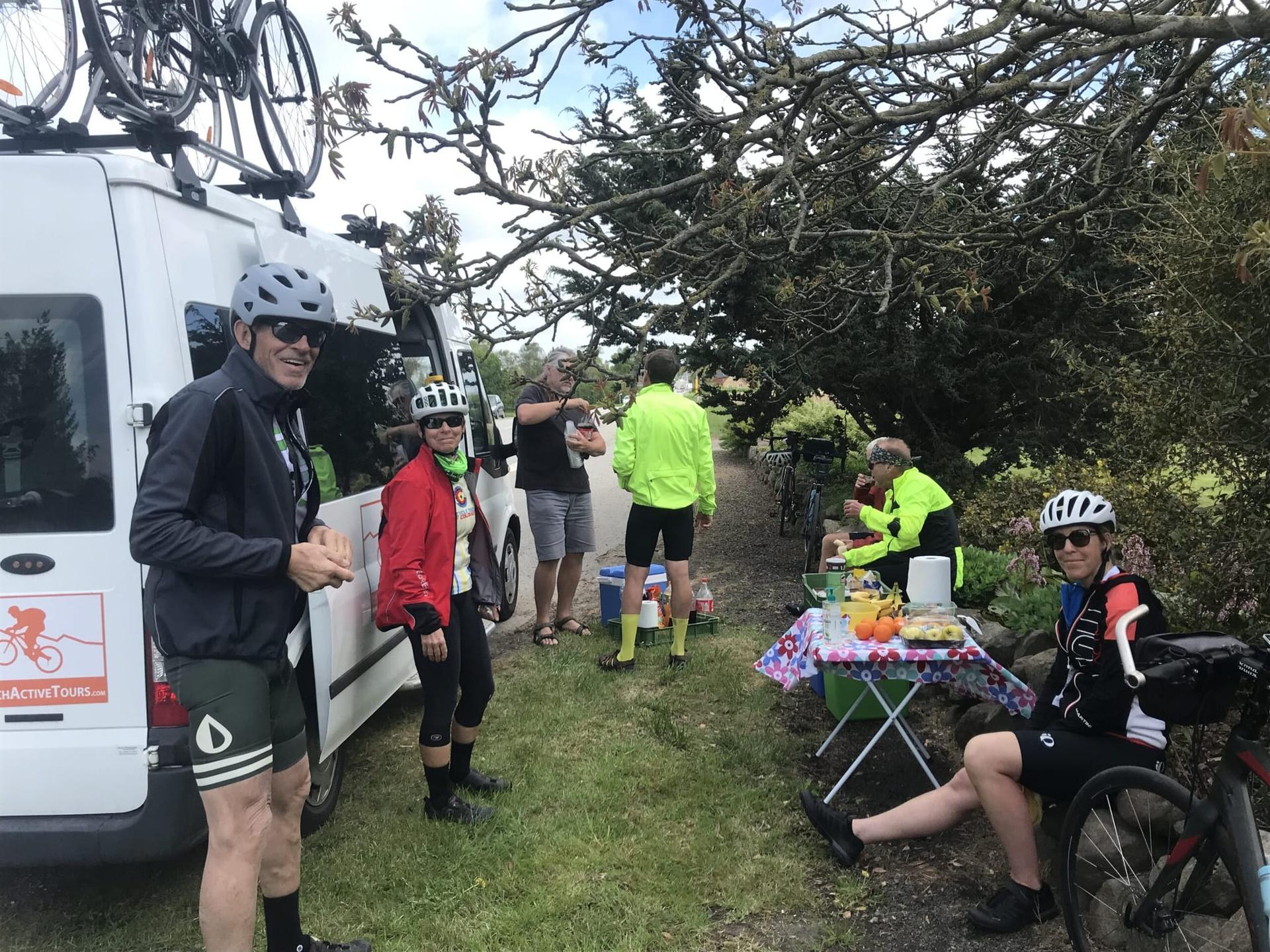
On a supported tour your luggage travels in the van, so there is no penalty for bringing the jacket you might not need. The van also carries water and snacks and stops with them along the route, which takes care of the warm afternoons.
Reading Averages Sensibly
A thirty-year average is the best guide there is to what a month is usually like, and no guide at all to a particular week. The figures here tell you what to pack and which months to prefer. They cannot tell you whether your three days will be the dry ones. Check a forecast from the national weather service in the days before you travel, and treat the averages as the reason your rain jacket and your sunscreen both go in the bag.
It also helps to remember what the averages measure. A daily maximum is usually reached in the afternoon, and a daily minimum around dawn. If you set off in the morning, the temperature you feel at the start is somewhere between the two and rising. Layers that come off easily and fit in a jersey pocket suit that pattern better than one warm jacket.
When Our Tour Runs
Our Berlin to Krakow tour reaches Poland on its eighth day and finishes in Krakow on its eleventh. We do not print departure dates in articles because they change from season to season. The current dates and price are on the tour page.
Whatever the date, the same rule holds on every one of our tours: you can ride as much as you want. If the hilly day arrives with rain, the van is an option for part of the day or all of it, and nobody keeps score. Weather is the one part of a cycling trip nobody can plan, and a van seat is the practical answer to it.
If you are adding days in Krakow before you fly home, the same averages apply to walking the city as to riding into it. Carry the jacket.
See the Berlin to Krakow Tour