
Polish traffic law treats a bicycle as a vehicle and its rider as a driver, with a handful of rules written specifically for cyclists. Most of them will feel familiar to anyone who rides on the road at home. A few will not: the duty to use a cycle path where one exists, the limits on riding side by side, and alcohol penalties that are a good deal stiffer than visitors tend to assume.
This guide sets out the rules as they stand in the Polish Road Traffic Act and in guidance published by the Polish police, and then explains what changes when you ride with a guide and a support van. It is a plain-language summary for riders, not legal advice. Rules change, and one of the helmet rules below is new in 2026, so check the official sources before you travel.
Cycle Paths Are Compulsory Where They Exist
The rule that most surprises visiting riders is in Article 33 of the Road Traffic Act. A person riding a bicycle is obliged to use the cycle path, the shared pedestrian and cycle path, or the cycle lane, if one is marked for the direction in which they are traveling or intend to turn. If the path is there and it goes your way, you ride on it rather than on the roadway beside it.
On a shared pedestrian and cycle path the same article requires the rider to take particular care and to give way to pedestrians. In practice that means slowing down on shared paths and treating them as a place to roll through rather than a place to hold your speed.
Riding Two Abreast
The starting point in Polish law is single file. The Act forbids a cyclist to ride on the roadway beside another road user. It then makes one exception: riding beside another bicycle or a moped is allowed exceptionally, provided it does not make movement difficult for other road users or otherwise endanger road safety.
Read that as permission for a quiet lane and not for a road with traffic waiting behind you. On our tours the ride leader calls it, and the group singles out when a vehicle needs to pass.
Children are covered by their own provisions. Under the amendment that took effect on June 3, 2026, a child aged up to 7 may be carried on a bicycle only on an additional saddle that makes the ride safe or in a child bike seat, and as a rule must wear a helmet. The Act also lets an adult who is looking after a rider aged up to 10 use the sidewalk with them. These rules matter mostly to families planning their own trip.
Hands, Feet and Phones
The same article sets three short rules of riding conduct, and a fourth comes from the general rules for drivers.
- Keep at least one hand on the handlebars and your feet on the pedals.
- Do not hold on to another vehicle.
- Do not ride beside another road user, apart from the exception described above.
- Do not use a hand-held phone while riding. The Act bans any driver of a vehicle from using a telephone that requires holding the handset or microphone in the hand while moving, and Polish police guidance for cyclists repeats it.
If you navigate by phone, mount it on the bars or stop to look at it. On a guided tour you have GPS files, cue sheets and a ride leader, so there is rarely a reason to have a phone in your hand on the move.
Sidewalks Are for Pedestrians, With Three Exceptions
A cyclist may use the sidewalk only exceptionally. The Act lists three situations.
- You are looking after a child aged up to 10 who is riding a bicycle.
- The sidewalk is at least 2 meters wide, it runs along a road where vehicles are allowed to travel faster than 50 km/h (about 31 mph), and there is no cycle path, shared path or cycle lane.
- The weather endangers a cyclist on the roadway. The Act names snow, strong wind, a downpour, glaze ice and dense fog.
Even then, a cyclist on the sidewalk must ride at a speed close to walking pace, take particular care, give way to pedestrians and not obstruct them.
Lights and Required Equipment
The Polish police list the equipment every bicycle on the road must have.
- A front position light, white or selective yellow.
- A red reflector at the rear.
- A red position light at the rear.
- At least one working brake.
- A bell or another warning signal that is not piercing.
The police make the point that lighting matters most after dusk. A small front and rear light is also worth carrying for a dark, wet day in the hills. If you rent a bike from us it comes with a rear luggage rack, bungee cord, spare tube and levers, water bottle cage, pump and lock. Ask us about lights and a bell when you reserve it, so you know what to bring.
Helmets: The Law and Our Own Rule
Poland changed its helmet law in 2026. According to the Polish government, from June 3, 2026 people under the age of 16 must wear a protective helmet when riding a bicycle, an electric scooter or another personal transport device. The rule was added to the Road Traffic Act by an amending act of October 17, 2025, published in the official journal that December. The same announcement says the parent or guardian can be fined up to 100 zloty if a child rides without one. The obligation applies to under-16s. Adult riders are not covered by it.
Our own rule is stricter than the law, and it is the one that applies to you on tour. The waiver every rider signs includes an agreement to wear an ANSI or Snell approved helmet at all times when riding a bicycle during the tour. A helmet is not part of the rental bike's equipment, so bring your own and make sure it fits.
Alcohol: A Low Limit and Heavy Fines
This is the rule to take seriously in a country with good beer. Polish police guidance sets out two tiers that have applied since January 1, 2022.
- Riding a bicycle after drinking, with a reading from 0.2 to 0.5 per mille, carries a fine of 1,000 zloty.
- Riding a bicycle while intoxicated, above 0.5 per mille, carries a fine of 2,500 zloty.
The lower threshold leaves no sensible room for a drink at lunch. The safe reading is no alcohol until the riding is finished. Our day into Zywiec ends at a town known for its brewery, with a visit possible in the afternoon, time permitting. Save the tasting for after the bikes are put away.
What Polish Law Asks of Drivers Around You
The Act also protects cyclists, and it helps to know what you are entitled to expect.
- A driver overtaking a bicycle must leave a gap of not less than 1 meter.
- A driver approaching a cycle crossing must take particular care and give way to a cyclist who is on the crossing.
- A driver turning into a side road must give way to a cyclist going straight ahead on the roadway, cycle lane or cycle path that the driver is about to cross.
- The speed limit in built-up areas is 50 km/h (about 31 mph), and 20 km/h (about 12 mph) in a residential zone.
Being entitled to priority is not the same as receiving it. Make eye contact at junctions, and do not assume that a driver turning across a cycle path has seen you.
The cycle crossing rule is the one to understand properly. A cycle crossing is the marked place where a cycle path crosses a road. The driver's duty is to a cyclist who is on the crossing, and Polish police guidance tells cyclists to take particular care when riding across one. Slow down as you approach, look both ways, and roll onto the crossing only when you are sure the driver has seen you and is stopping.
Road Conditions on Our Polish Days
We ride three days in Poland on the Berlin to Krakow tour: the arrival in Cieszyn, the day from Cieszyn to Zywiec at 69 km (43 miles), and a short final day of 27 km (17 miles) before a bus shuttle to Tyniec and a ride along the river into Krakow. The itinerary describes the Zywiec day as hilly, and there are a few hills on the last day as well.
Hills mean descents. Brake before a bend rather than in it, leave room between you and the rider ahead, and be more careful still if the road is wet. The tour's own difficulty note says that, apart from a few short sections of firmly packed dirt, the roads and bike paths are paved, and that we design the route along small, quiet roads with as little car traffic as possible. The final approach to Krakow is along the Vistula.
If Something Goes Wrong, and What the Van Changes
The emergency number in Poland is 112. The European Commission describes it as the European emergency number, available everywhere in the EU free of charge, from fixed and mobile phones, for an ambulance, the fire brigade or the police. It works alongside the national emergency numbers.
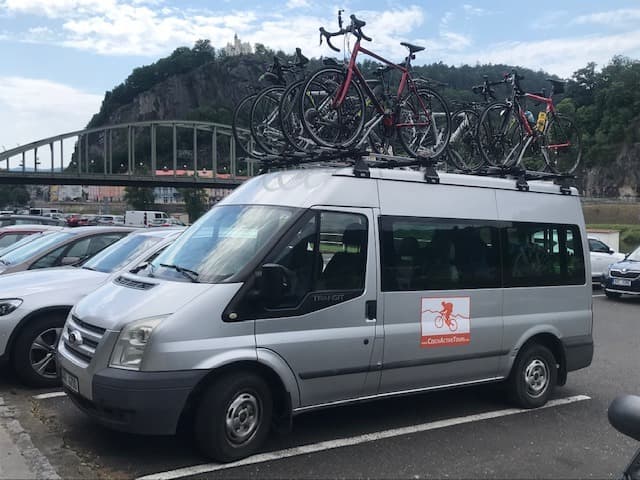
On tour, your first call is to your guide. Every tour comes with emergency phone numbers, a bilingual tour guide and ride leader on the route, and a van that carries tools and spares. A puncture or a slipping gear is the van's job. A fall, however minor it looks, is something to tell the guide about straight away rather than at dinner.
A tired rider makes worse decisions: the late-afternoon descent taken a little too fast, the junction misread at the end of a long day. The van is the answer to that. On any of our tours you can ride as much as you want and shorten your time in the saddle, for part of a day or all of it, and you do not need to justify it.
It also takes the weight off the bike. Your luggage travels between hotels, so you descend the Beskid hills on an unloaded bike that handles the way it should. The current price and dates for the tour are on the tour page.
See the Berlin to Krakow Tour