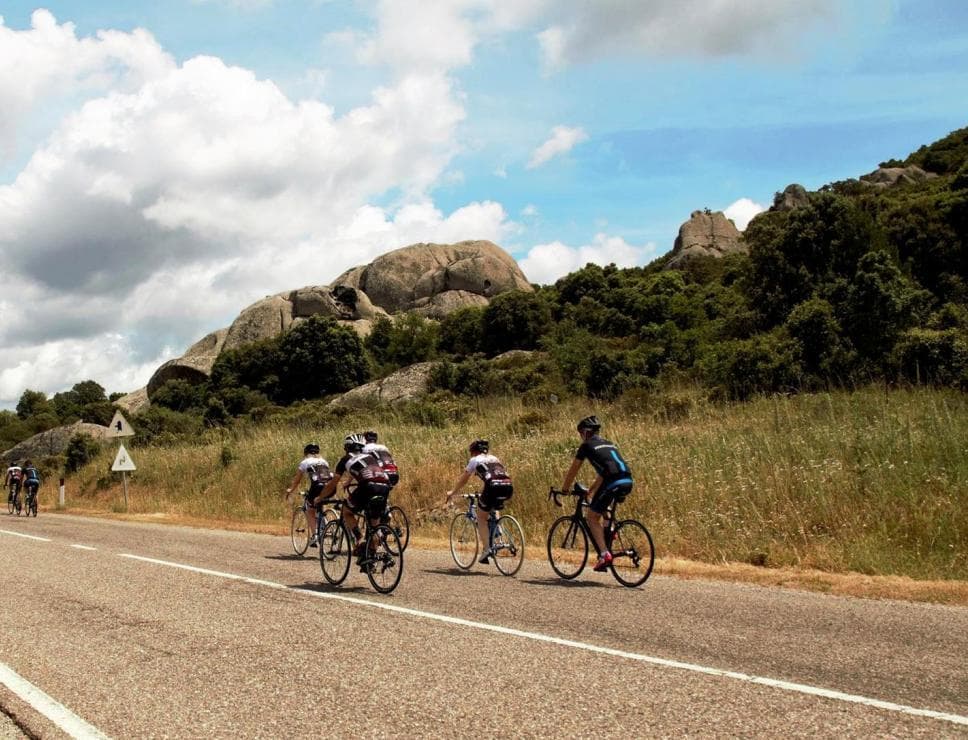
Sardinia does not have one famous long-distance cycle route in the way the Danube or the Loire does. What it has is a road network that suits a road bike: provincial roads that follow the coast, climb into the interior and connect towns a day's ride apart. The routes riders talk about are stretches of those roads, known by the towns at each end.
This guide goes through the ones that matter, says what the regional authorities are building, and is clear about which of them our Best of Sardinia Cycling Tour rides. The tour is a loop from Olbia, so it touches most of the north of the island and none of the south.
The Alghero to Bosa Coast Road
The regional tourism board calls the first stretch of its west-coast cycling itinerary one of the most popular, and this road is the reason. Leaving Alghero southward, the provincial road SP 105 follows the coast toward Bosa. The regional tourism board describes it as one of the most panoramic roads on the island: an asphalt road that runs along the coast overlooking the sea, with bends and uphill and downhill stretches. By its count, Bosa comes at kilometer 42, about 26 miles from Alghero.
North of Bosa the coast reaches the volcanic headland of Capo Marrargiu, a nature reserve where griffon vultures, a rare bird of prey, nest on the rock faces above the sea. The birds give this shoreline its local name, the coast of the griffons.
Our tour rides between Alghero and Bosa on Day 5, a stage of 64 km (40 miles). The itinerary calls it one of the most scenic rides of the tour and is honest that there are a number of climbs. The distance is short enough that nobody needs to hurry them.
The North Coast From Olbia to Castelsardo
The north coast is the part of Sardinia that professional racing has shown to the widest audience. The 2017 Giro d'Italia opened on the island, and its first stage ran 206 km (128 miles) from Alghero to Olbia along the northern coast. The race's own description of that stage is a fair account of the terrain for anyone on a bike: a long, steady sequence of constant undulations, with a number of short, steep ramps.
We ride this coast in the opposite direction and over three days. Day 2 goes from Olbia to Palau, 45 km (28 miles), through granite outcrops and Mediterranean scrub. Palau is the harbor town that faces the Maddalena Archipelago National Park, and the last kilometers bring the islands into view. Day 3, Palau to Castelsardo, is 84 km (52 miles) of rolling hills along the northern shore. Day 4 continues west to Alghero, 70 km (43 miles).
Castelsardo is the natural overnight stop on this coast. It is a fortified medieval town on a promontory in the Gulf of Asinara, built around a castle that the Doria family of Genoa probably raised in the 13th century. The castle now houses a museum of Mediterranean basket weaving, and entry to it is part of our tour.
The West Coast South of Bosa
The regional tourism board promotes a much longer west-coast itinerary than the one stage most visitors know. It runs from Alghero to Cagliari, almost 400 km (about 250 miles), on what it describes as mostly provincial, municipal and urban secondary roads, with sections of state road and cycle path. The first stretch, Alghero to Cabras, is about 100 km (62 miles) and includes the SP 105.
South of Bosa the route climbs through Malvasia vineyards to Cuglieri, drops to the lagoons around Cabras and the Sinis peninsula, and continues through Oristano toward the south of the island. It is a week of riding in its own right.
We do not ride it. Our tour leaves the west coast at Bosa and turns inland. We mention the southern continuation because it is the obvious next trip for a rider who has done the north and wants more of the island.
Across the Interior From Bosa to Orosei
The interior is a different island from the coast, and our route crosses it in two days. Day 7, Bosa to Bolotana, is 56 km (35 miles): the itinerary describes steady climbs into the mountainous interior and a sense of quiet remoteness. Day 8, Bolotana to Orosei, is 85 km (53 miles) and is named as the most demanding day of the tour, with significant elevation gain, long climbs and long descents before the land softens toward the east coast.
These are the two days that earn the tour its grade. The climate changes with the height as well. The regional tourism board notes that the interior is a few degrees cooler than the coast, which is welcome on a climb and worth a layer in the van on a descent.
The East Coast From Orosei to Olbia
The east coast between Orosei and Olbia is beach country. Orosei is a town of about seven thousand people in the Cedrino valley, two and a half kilometers from the sea, with a coastline of white sand and cliffs. San Teodoro, further north, is a resort town whose winter population of under five thousand rises to tens of thousands in summer. Its beaches look across to the island of Tavolara and its protected marine area.
We ride Orosei to San Teodoro on Day 9, 73 km (45 miles) of more moderate coastal terrain, and San Teodoro back to Olbia on Day 10, an easy 30 km (19 miles) to close the loop.
The Ciclovia della Sardegna, the Island Ring Being Built
Sardinia's regional government has a long-term plan for cycling, and it is worth knowing what stage it has reached. The plan defines a regional cycle network, and within it the Ciclovia della Sardegna, a ring of more than 1,100 km (about 680 miles) that would cross all four provinces and link every port and airport on the island. As designed, it starts in Alghero and runs clockwise around the coast through Porto Torres, Olbia, Tortolì and Villasimius to Cagliari, then returns north through the interior.
The ring is made up of 19 itineraries, each divided into sections of no more than 30 km, and it has been part of Italy's national system of tourist cycle routes since 2017. It is not finished. The region has named the western axis from Alghero to Cagliari as the priority and reports that work is currently concentrated on three itineraries in the south and west: Cagliari to Barumini, Barumini to Oristano, and Oristano to Bosa.
In practice, a rider touring Sardinia today is riding roads shared with other traffic, not a continuous waymarked cycle route. That is no hardship on quiet provincial roads, but it does mean the route has to be chosen with care. On our tour that choice is made for you and handed over as cue sheets and GPS files.
How Sardinia Fits Into Italy's Route Networks
At the national level, Italy is crossed by four EuroVelo routes: EuroVelo 5, the Via Romea Francigena; EuroVelo 7, the Sun Route; EuroVelo 8, the Mediterranean Route; and EuroVelo 9, from the Baltic to the Adriatic. The national network, Bicitalia, comprises 20 national routes.
We ride none of the mainland routes. Our only Italian tour is the Sardinian one, and it would be dishonest to write about the others as though we knew their surfaces and their cafes. For Sardinia we can be specific.
Which of These Routes Our Tour Rides
- North coast: Olbia to Palau (45 km / 28 miles), Palau to Castelsardo (84 km / 52 miles), Castelsardo to Alghero (70 km / 43 miles).
- West coast: Alghero to Bosa (64 km / 40 miles), followed by a rest day in Bosa.
- Interior: Bosa to Bolotana (56 km / 35 miles) and Bolotana to Orosei (85 km / 53 miles).
- East coast: Orosei to San Teodoro (73 km / 45 miles) and San Teodoro to Olbia (30 km / 19 miles).
That is eight riding days and 507 km (315 miles) in total. The rest day falls in Bosa, a river town of colored houses under the Malaspina castle, built in 1112 on the hill of Serravalle. From the castle walls you look down on the multicolored house fronts along the right bank of the river Temo and the old tanneries on the opposite bank. Entry to the castle is included.
What the Roads Are Like to Ride
Our route is designed to follow small, quiet and scenic roads with minimal traffic. The tour's difficulty note says any type of bike is suitable, whether a road bike, a touring or hybrid bike, or a mountain bike, depending on what you are most comfortable riding.
Two things about riding on Italian roads are worth knowing before you arrive. Outside built-up areas the law requires cyclists to ride in single file, so the habit of riding two abreast on an empty road does not transfer. And the coast roads here are rarely flat. The Giro's phrase, constant undulations, describes them well. You are seldom climbing for long, but you are seldom coasting either.
Choosing Between Coast and Interior
Riders planning their own trip often ask whether to stay on the coast or go inland. The coast has the views, the towns and the swimming. The interior has the long climbs, the empty roads and a side of the island that beach visitors do not see. The interior stages are also the harder ones.
Our answer was to do both, in an order that puts the hardest riding after the rest day. Four days on the coast come first, then a day off in Bosa, then the two interior stages, then two easier days back along the east coast. If you would rather skip a climb, the support van will carry you over it, and you can ride the coast on either side.
The current dates and price are on the tour page, along with the full day-by-day itinerary.
See the Best of Sardinia Cycling Tour