We run guided, supported tours, so you should read this comparison knowing which side of it we stand on. We have tried to write it the way we would explain it to a friend who rides well and is not sure whether to pay for a guided trip. For some riders on Sardinia, going independently is the right answer. For others the island makes a stronger case for support than most places do.
The differences that matter here are specific to Sardinia: a road network without a finished long-distance cycle route, two hard days in a thinly populated interior, Italian traffic rules that catch visitors out, and the plain logistics of an island.
What Each Option Means
A guided tour, as we run it, means a fixed route and dates, hotels booked for every night, a tour guide and ride leader on the route, and a support van that carries the luggage, stops with snacks and water, holds the tools and spares, and gives lifts. You ride with a group and eat some of your dinners together.
Self-guided covers a range. At one end you plan everything yourself: route, hotels, bike, bags. At the other, a local operator books hotels and moves luggage while you ride alone with a GPS track. What every version has in common is that nobody is on the road with you.
Navigation Without a Finished Cycle Route
On the Danube or along the North Sea you can follow signs for a week. Sardinia is not like that yet. The regional government is planning the Ciclovia della Sardegna, a ring of more than 1,100 km (about 680 miles) around the island, and it is being built in stages. The region's own project site reports work concentrated on three itineraries in the south and west. Until the ring exists, a tour of the island is a route somebody has stitched together from provincial roads.
An independent rider does that stitching with mapping apps, and it is usually fine on the coast, where one road follows the sea. It is harder inland, where the choice between a quiet road and a busy one is not obvious from a map.
On our tour the route arrives as cue sheets and GPS files, and a ride leader is on the road. We design it to follow small, quiet, scenic roads with minimal traffic. That local knowledge is one of the main things you are paying for.
Luggage on a Hilly Island
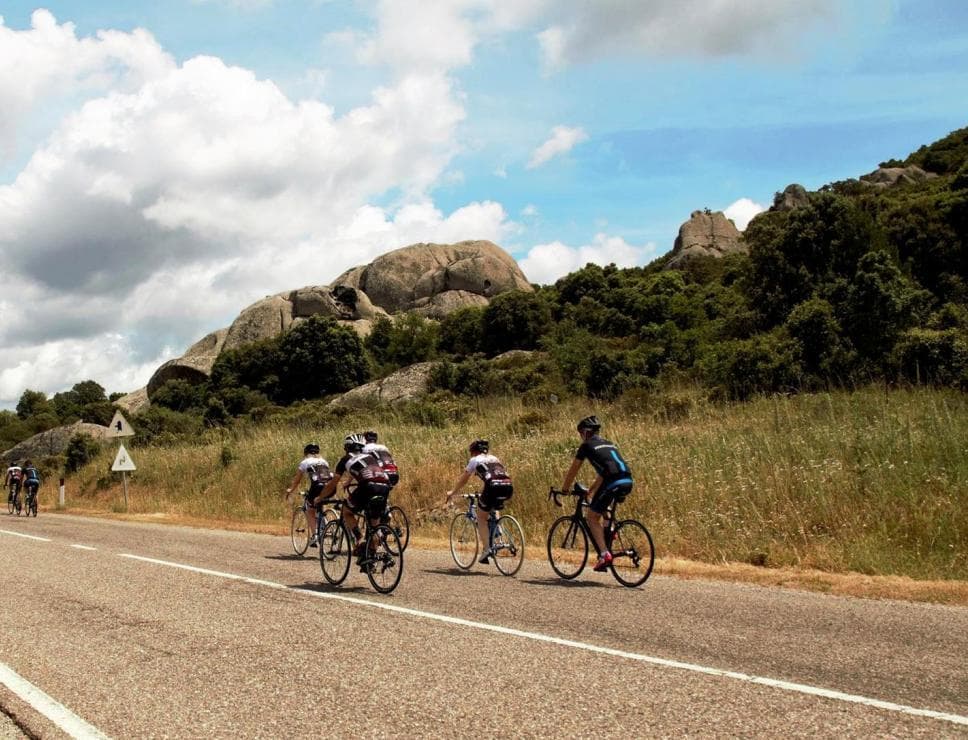
Our route is 507 km (315 miles) over eight riding days, and it is not flat. The coast stages roll constantly, and the two interior stages climb steadily. Carrying your own luggage over that changes the trip. A loaded bike climbs slowly, descends heavily and wants lower gears than an unloaded one.
There are three ways around it. You can travel very light. You can book a self-guided package that includes luggage transfers. Or you can ride a supported tour, where the bags go in the van and are in your room when you arrive. The third is the only one in which the vehicle that carries your bags can also carry you.
The Interior Days Are Where Support Counts
Six of our eight riding days follow the coast and its towns. Days 7 and 8 are different. From Bosa the route heads inland to Bolotana, 56 km (35 miles) of steady climbing into what the itinerary calls a more rugged and less-traveled part of Sardinia. The next day, Bolotana to Orosei, is 85 km (53 miles) and the most demanding of the tour, with significant elevation gain, long climbs and long descents.
For a self-guided rider these are the days that need planning: how much water to carry, where the next food is, what to do about a mechanical problem far from a bike shop, what to do if the weather turns in the hills. None of that is beyond a competent, self-sufficient cyclist. It does mean carrying more and leaving less to chance.
On a supported tour the same two days have a van behind them with water, food, tools and a seat. You can ride every kilometer, or you can ride the climb and skip the long drag after it. You make that decision on the road, not weeks earlier at a desk.
Italian Road Rules a Visitor Needs to Know
An independent rider is also their own compliance department. Three rules of the Italian Highway Code are worth knowing, because none of them is intuitive to a visitor.
- Outside built-up areas cyclists must ride in single file. Two abreast is allowed only in towns, and only when traffic permits.
- A reflective vest or reflective braces are compulsory in tunnels, and outside towns from half an hour after sunset to half an hour before sunrise.
- Where a cycle path or cycle lane exists, cyclists must use it.
The bike itself must have two working brakes, a bell, front and rear lights and reflectors. The Code does not require a helmet. We do, on our tours. A guide does not make you exempt from any of this, but a guide who rides these roads will tell you before the tunnel, not after it.
Language and Things Going Wrong
You do not need Italian to order a coffee. You may want it to explain a snapped gear cable to a mechanic in a small inland town, to rearrange a hotel booking after a missed stage, or to describe where you are on the phone. On a guided tour those conversations are the guide's job.
In an emergency the number in Italy is 112, the European emergency number, free from any phone. Beyond that, a self-guided rider relies on their own phone, their own insurance and, if they booked a package, the operator's helpline. A guided rider has a guide on the route and a van that can reach them.
Getting There, and Getting a Bike There
Sardinia is an island, and every bike on it arrived by plane or by sea or was rented locally. Our tour starts and ends in Olbia, which has its own airport a few kilometers from the city center, so one return journey covers the trip whichever way you ride it.
If you bring your own bike, the airline leg is the same either way. The difference comes afterward. On a guided tour you can rent a serviced Fuji road or fitness bike from us and skip the bike bag altogether, or bring your own and have mechanical support for it. On an independent trip you arrange a rental yourself or travel with the bike, and you need somewhere to leave the bag while you ride a loop.
Trains are a limited fallback on a route like this. Trenitalia's standing rule is that one bicycle per passenger travels free when it is dismantled and in a bag, or is a folding bike properly closed, within 80 x 110 x 45 cm. The conditions for carrying an assembled bike vary by service and region. Do not count on a train to rescue a bad day unless you have checked that particular line.
Pace, Company and Freedom
This is the argument for going alone, and it is a real one. Self-guided, you start when you like, stop where you like, and stay a second night in Alghero if the town deserves it. You ride at exactly your own speed and nobody waits for you or makes you wait.
A guided tour is more flexible than its reputation. You carry the route yourself as cue sheets and GPS files, the van makes snack stops along the way, and you can ride as much or as little of a day as you want. The rest day in Bosa is yours to spend as you wish. But the dates are fixed, the hotels are fixed, and you share the week with other people. If that sounds like a cost and not a benefit, self-guided is probably your trip.
Comparing the Cost Fairly
A self-guided trip will often have the lower headline price, since there is no guide or van to pay for. The comparison is only fair when both columns hold the same lines. Ours includes the hotels, breakfast every morning, six dinners, luggage transport, van support with snack stops, the walking tour in Olbia and entry to the castles in Castelsardo and Bosa. Add those to an independent budget, along with luggage transfers, before deciding which is cheaper.
Who Each Option Suits
Self-guided suits a rider who is mechanically self-sufficient, comfortable navigating from a GPS track on unfamiliar roads, happy to carry luggage or to pay for transfers, and wants full control of dates and pace. It works best for people who have toured before and who would enjoy the planning.
Guided suits a rider who wants to do the hard stages without being committed to finishing them, who is traveling alone and would like company at dinner, who is riding with a partner of different strength, or who has limited vacation time and does not want to spend any of it solving problems. It also suits anyone who wants the option of a rental bike that is ready on arrival.
The fair summary is that Sardinia's coast is a reasonable place to ride independently, and Sardinia's interior is where a support van proves its worth. Our tour does both, which is why we run it the way we do. The current dates and price are on the tour page.
See the Best of Sardinia Cycling Tour