Most of what keeps a cyclist safe in Italy is the same as anywhere: be visible, be predictable, look after your brakes. But Italian traffic law has a few rules that differ from what riders from North America, Australia or northern Europe are used to, and one of them changes how a group rides on an open road.
This guide sets out the rules that apply to cyclists under the Italian Highway Code, the Codice della Strada, and then turns to Sardinia, where our only Italian tour runs. It is a plain-language summary and not legal advice. Laws are amended, so check the current text or an official source before you travel.
The Rule That Surprises Visitors: Single File Outside Towns
Article 182 of the Highway Code is the article on cyclists. Its first paragraph says cyclists must ride in single file whenever traffic conditions require it, and in any case never more than two abreast. It then adds the part visitors do not expect: outside built-up areas, cyclists must always ride in single file. The one exception is when one of the riders is a child under ten, riding on the right of the other.
In other words, the sociable two-by-two formation that Spain and Portugal allow on open roads under certain conditions is not legal on an open road in Italy. The State Police's own guidance for cyclists puts it firmly. Inside towns the rule is left to the rider's judgment of the traffic. Outside them it is a precise obligation with no exceptions beyond the one for a child.
The Code does make an exception for certain designated cycling streets, shared cycle and pedestrian routes and cycle zones. Those are specially designated cycling facilities, not ordinary provincial roads.
Hands, Passengers and Being Towed
The rest of Article 182 is mostly common sense written down. A cyclist must have free use of arms and hands and hold the handlebar with at least one hand. You must be able to see freely ahead and to both sides and to make any maneuver promptly. Cyclists may not be towed by another vehicle, so holding on to a car or a van on a climb is an offense as well as a bad idea.
Where traffic conditions mean a cyclist would obstruct or endanger pedestrians, the cyclist must dismount and walk the bike, and is then treated as a pedestrian. That is the rule to remember in the narrow lanes of an old town.
Cycle Paths Are Compulsory Where They Exist
Article 182 also says that bicycles must use the cycle paths or cycle lanes reserved for them where these exist. In Italy a cycle path beside the road is not an option you may decline in favor of the carriageway. The State Police guidance says the same: where a signed cycle path runs beside the road, cyclists are obliged to use it.
Lights, Bell and Reflectors
Article 68 lists what a bicycle must carry. It needs an independent brake for each wheel, a bell, white or yellow lights at the front, red lights and red reflectors at the rear, and yellow reflectors on the pedals and on the sides. The lights have to be fitted and working when the Code requires lights to be used.
On a daytime tour you may never switch a light on outside a tunnel. Fit them anyway. A small rear light is useful in poor weather, and tunnels have their own rule, which comes next.
The Reflective Vest Rule
A cyclist riding outside built-up areas from half an hour after sunset until half an hour before sunrise must wear a high-visibility reflective vest or reflective braces. So must a cyclist riding through a tunnel, at any time of day. This is in Article 182 as well.
If you ride only in daylight, the night-time half of the rule does not arise. The tunnel half applies at any hour. A reflective gilet folds to nothing in a jersey pocket and covers both cases.
Helmets: What the Law Says and What We Require
The Highway Code does not require cyclists to wear a helmet. Article 182 sets out the cyclist's obligations and a helmet is not among them.
Our own rule is stricter. Every rider on a Best European Bike Tours trip signs a waiver that includes an agreement to wear an approved helmet at all times when riding during the tour. Our rental bikes do not come with one, so bring your own and check that it still fits over a cap.
Alcohol and the Long Lunch
Drink-driving law in Italy is not only for motorists. The State Police state that a cyclist must be physically and mentally fit to ride, cannot ride drunk, and that the penalties for driving under the influence apply to cyclists too. Under Article 186 of the Code, a driver is considered to be under the influence above 0.5 grams of alcohol per liter of blood.
On a tour through wine country this matters at lunch. Our Sardinia tour includes an optional wine tasting. Enjoy it once the bike is put away for the day.
How Drivers Must Overtake You
The Code also puts a duty on the driver behind you. Article 148 says that a motor vehicle overtaking a bicycle must leave adequate lateral distance, taking account of the speeds involved and the bicycle's reduced stability, and must keep a safety distance of at least 1.5 m (about 5 feet) where road conditions allow it.
Note the qualification. On a narrow road the law does not guarantee you a meter and a half. Ride a steady line, do not weave around potholes at the last moment, and on a climb leave room between riders so that a car can pass in stages.
The Rules in Brief
- Single file outside built-up areas, always. Never more than two abreast anywhere.
- At least one hand on the handlebar, and no being towed.
- Use the cycle path or lane where one exists.
- Bell, two working brakes, front and rear lights, reflectors.
- Reflective vest or braces after dark outside towns, and in every tunnel.
- No helmet law for cyclists, but a helmet is required on our tours.
- The drink-driving rules apply to cyclists.
Article 182 backs its rules with an administrative fine. We have left the amounts out because amounts change, and the figure that matters is the one in force when you ride.
Want a ride leader on Sardinia's roads? See our Best of Sardinia Cycling Tour or call 269-760-6349.
Sardinian Road Conditions
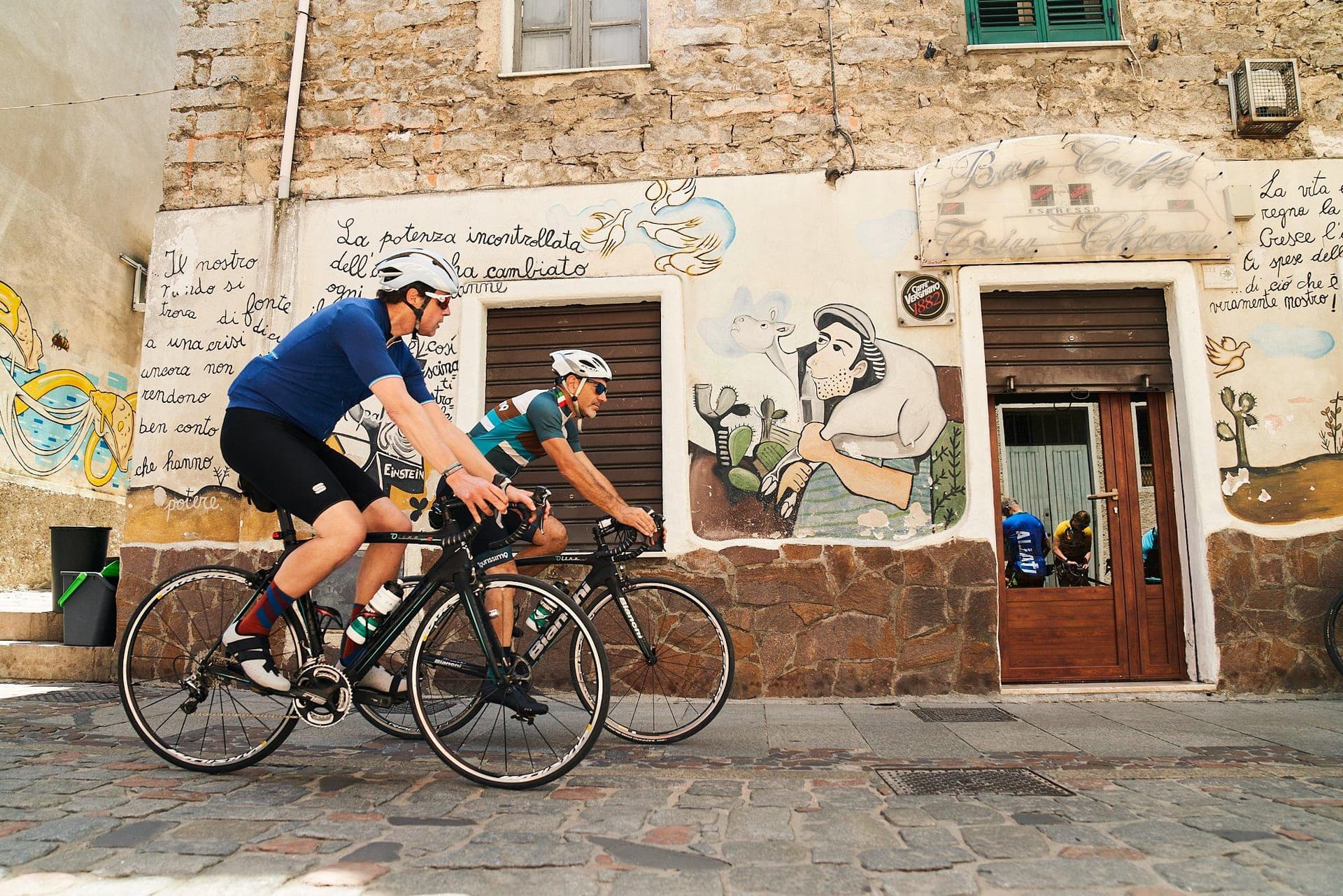
Our Sardinia route is designed to follow small, quiet and scenic roads with minimal traffic. That is the tour's own description, and it is the main safety measure on any cycling trip: choosing roads where there are few cars.
The terrain asks for attention, though. The north coast was used for the opening stage of the 2017 Giro d'Italia, and the race described it as a long, steady sequence of constant undulations with a number of short, steep ramps. The coast road from Alghero to Bosa is described by the regional tourism board as asphalt along the sea with bends and uphill and downhill stretches. The two interior stages, Bosa to Bolotana and Bolotana to Orosei, bring steady climbs and long descents.
Three habits are worth forming before you arrive.
- Brake before a bend, not in it, and stay on your side of the road through blind corners. A coast road with a view on one side tempts riders toward the center line.
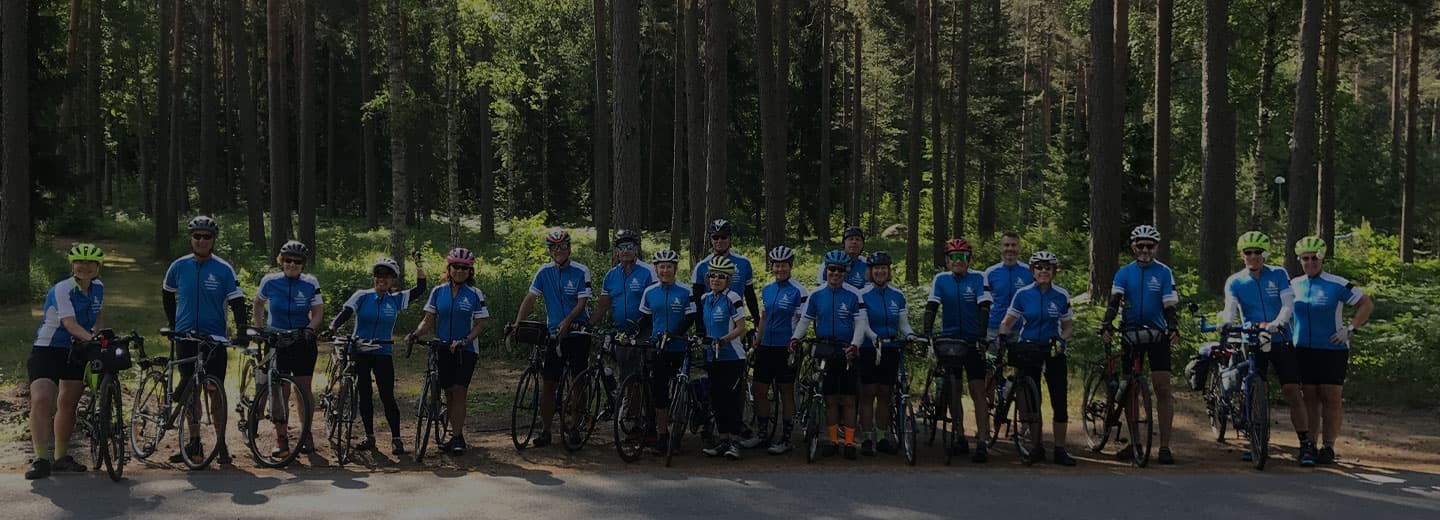
- Leave gaps. Riding in single file is the law outside towns, and a line of riders with space between them is easier for a driver to pass than a tight bunch.
- Expect the season to change the traffic. San Teodoro, one of our overnight towns, has fewer than five thousand residents in winter and tens of thousands of people in summer, according to the regional tourism board.
Wind is the other variable. The maestrale, the wind from the north-west, can turn a rolling coastal stage into a hard one. On exposed headlands, keep both hands on the bars and give the rider in front more room than usual.
Emergencies, and What the Support Van Changes
The emergency number in Italy is 112, the European emergency number, which is available everywhere in the European Union free of charge. Save it in your phone, along with the emergency phone number we give you for the tour.
On a supported tour you are rarely the first responder to your own problem. A guide and ride leader are on the route, and the van follows with tools, spares, water and snacks. A puncture, a broken spoke or a rider who has simply had enough is dealt with by people who know where the next town is. The van will also carry you over any stretch you would rather not ride, for part of a day or all of it.
What the van does not change is the law. You still ride in single file outside towns, you still need lights and a reflective vest for a tunnel, and you still need to be sober. If you take a bike on an Italian train before or after the tour, Trenitalia carries one bicycle per passenger free of charge when it is dismantled and in a bag, or is a folding bike properly closed, within 80 x 110 x 45 cm.
Know the rules, ride predictably, and Sardinia's quiet roads are a very good place to spend a week on a bike.
See the Best of Sardinia Cycling Tour