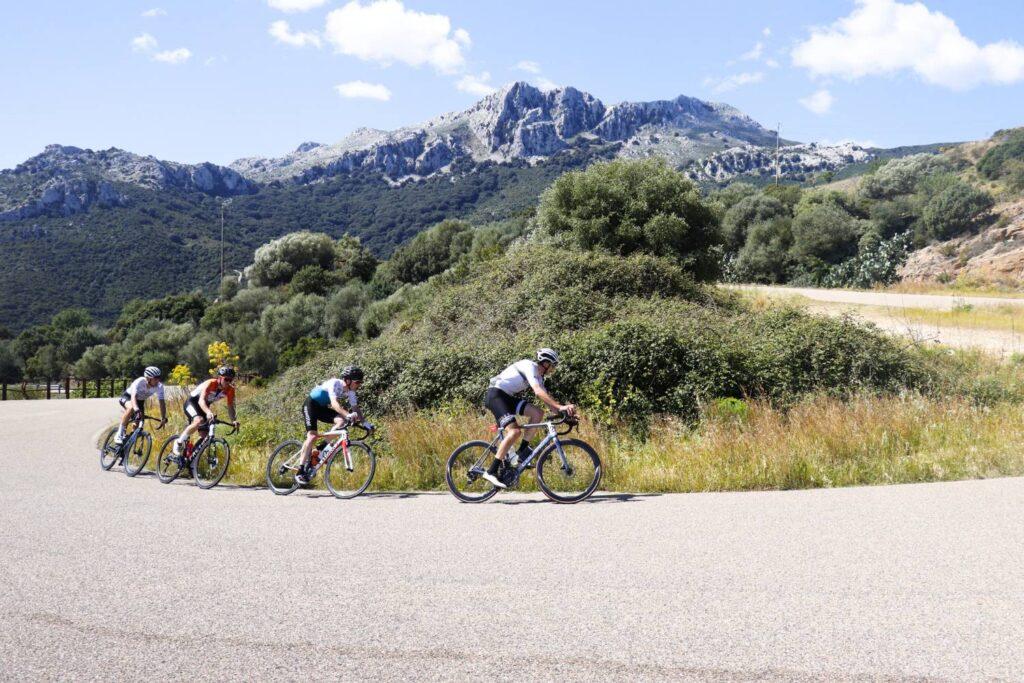
The short answer: cycling in Sardinia is harder than the distances suggest. The island is hilly almost everywhere, its mountains reach 1,834 m (6,017 ft) at Punta La Marmora, and the coast roads rarely stay flat for long. Our tour averages about 63 km (39 miles) a day, but two back-to-back interior days carry most of the climbing, which is why we grade it Demanding.
Demanding is the top of our three difficulty levels. That word puts some riders off who would manage the tour comfortably, and it fails to warn others who look at the daily distances and conclude it is easy. Neither group is reading the grade correctly, so this guide explains it.
It covers what the grade means, what the distances are, where the hard riding falls, and how to prepare for this tour in particular. It is not a general training plan. We have published a week-by-week plan in our guide to training for a multi-day tour in Portugal, including a twelve-week version for demanding tours, and that plan works for Sardinia too. What follows is about what is different on this route.
Is Sardinia Good for Cycling?
Yes, for riders who like hills. The regional tourism board describes cycling on the island in terms of a mild climate, captivating scenery and not much traffic on the roads, some of them sometimes deserted. It lists routes of varying difficulty for expert cyclists and amateurs, on road bikes or mountain bikes, along the coast or inland, and it recommends spring or autumn for riding.
What Sardinia does not offer is much flat ground. The Gennargentu massif rises in the middle of the island, and even the coast roads climb over headlands between the bays. That is the reason our tour carries the grade it does, and the rest of this guide is about what the grade means once you are on the bike.
What Demanding Means in Our Grading
We sort our tours into three difficulty levels. The first asks that you can ride 20 to 50 km (15 to 35 miles) a day on mostly flat or gently rolling terrain. The second asks that you can complete days of 60 to 85 km (40 to 60 miles) comfortably on rolling to moderately hilly terrain. The third, Demanding, reads as follows: you should come well prepared and be an experienced rider, ready to complete 80 to 110 km (50 to 65 miles) per day on moderately hilly to hilly terrain, able to complete several climbs on the route, and able to descend long and sometimes steep hills and use your brakes properly.
A Demanding grade therefore says three things. The days are long, there are climbs, and there are descents that need skill. A tour does not need all three at full strength to earn it.
Cycling Sardinia Stage by Stage: Distances and Terrain
These are the stage distances as the itinerary gives them, with the itinerary's own description of each day's terrain.
| Day | Stage | Distance | Terrain, in the itinerary's words |
|---|---|---|---|
| Day 2 | Olbia to Palau | 45 km (28 miles) | Quiet roads through the rolling hills of the Gallura region |
| Day 3 | Palau to Castelsardo | 84 km (52 miles) | Rolling hills along the northern coastline |
| Day 4 | Castelsardo to Alghero | 70 km (43 miles) | A mix of gentle climbs and sweeping descents |
| Day 5 | Alghero to Bosa | 64 km (40 miles) | Coast road with a number of climbs |
| Day 6 | Bosa | Rest day | Optional rides or excursions |
| Day 7 | Bosa to Bolotana | 56 km (35 miles) | Steady climbs into the mountainous interior |
| Day 8 | Bolotana to Orosei | 85 km (53 miles) | The most demanding day: long climbs and long descents |
| Day 9 | Orosei to San Teodoro | 73 km (45 miles) | More moderate terrain along the east coast |
| Day 10 | San Teodoro to Olbia | 30 km (19 miles) | A shorter, easygoing ride back to Olbia |
That is 507 km (315 miles) over eight riding days, an average of a little over 63 km (39 miles). Only two days pass 80 km. The tour's own difficulty note asks that you be comfortable riding 60 to 85 km (35 to 55 miles) per day over rolling terrain, with some occasional climbs.
Why the Grade Is Higher Than the Distances Suggest
Measured by distance, most of these stages sit in the range of our middle grade. The grade comes from the terrain, and above all from two consecutive days.
Day 7 leaves the coast at Bosa and, in the words of the itinerary, becomes more challenging, with steady climbs leading into the island's mountainous interior. It is only 56 km, and it is a hard 56. Day 8 follows directly and is described as the most demanding day of the tour, featuring significant elevation gain, long climbs and long descents over 85 km. The longest stage, with the most climbing, comes on legs that climbed the day before.
The coast days are not flat either. Day 3 is 84 km of rolling hills along the north coast. Day 5, from Alghero to Bosa, has a number of climbs. When the 2017 Giro d'Italia raced along the north coast between Alghero and Olbia, the organizers described the stage as a long, steady sequence of constant undulations with short, steep ramps. On terrain like that you are almost always either pushing or braking.
How the Tour Is Built
The order of the stages helps you. The tour opens with 45 km, a distance that lets you settle on the bike, check your position and get used to a rental if you have one. The longest coastal day comes second, while you are fresh. Two medium days follow.
Then comes the rest day in Bosa, placed immediately before the interior. You start Day 7 on rested legs. After Day 8 the route eases, with 73 km of more moderate coastal terrain and a final 30 km back to Olbia.
So the shape of the tour is four days of rolling coast, a day off, two hard days, and two easier ones. The preparation that fits it best follows the same shape.
Preparing for Four Days in a Row
The first block asks you to ride 45, 84, 70 and 64 km on consecutive days, which is 263 km (163 miles) in four days. Almost any regular rider can do one 84 km ride. The question is whether you can do it and then ride 70 km the next morning.
The only way to find out is to try it at home. In the last two months before the tour, ride at least one block of three or four consecutive days at close to these distances. It does not need to be fast. You are testing the things that only show up on day three: the saddle, the hands, the neck, and how much you need to eat to start a ride properly fueled when you finished one sixteen hours earlier.
If something hurts on day three at home, it will hurt on day three in Sardinia. Two months is enough time to change a saddle or a stem. The week before you fly is not.
Preparing for the Two Interior Days
The climbing on Days 7 and 8 is described as steady and long. That calls for a different effort from the short ramps of the coast. The skill is to settle into a pace you could hold for the whole climb and to keep to it when the rider ahead of you does not.
If you have long hills near home, ride them at a pace that still lets you talk. If you live somewhere flat, a sustained effort into a headwind or on an indoor trainer is the nearest substitute: twenty or thirty minutes of even pressure on the pedals, repeated after a rest. Then do the thing that matters most for this tour. Put a hilly ride and a long ride on consecutive days, in that order, because that is what Days 7 and 8 are.
Gearing matters more than fitness on a long climb. If you are bringing your own bike, fit the lowest gears it will take. Nobody finishes a mountain day wishing they had left the easy gears at home.
Descending Is Part of the Grade
The Demanding description ends with a sentence that training plans tend to skip: you need to know how to descend long and sometimes steep hills and how to use your brakes properly. Day 8 has the long descents, toward the east coast. The coast roads add bends above the sea.
Practice it on purpose. Brake before the corner, release as you turn, look where you want to go, and keep your weight low. If you rent a bike from us, use the first easy day to learn how its brakes feel. Our rental bikes are fully serviced, but every bike brakes a little differently from the one in your garage.
Sardinia Road Cycling: Road Bike, Hybrid or E-Bike?
The tour's difficulty note says all types of bikes suit this route: a road bike, a touring (hybrid) bike or even a mountain bike, whichever you are most comfortable riding. If you rent from us, the choice is between Fuji fitness bikes with flat handlebars and Fuji road bikes with drop handlebars, and electric bikes of a hybrid or mountain bike type are available on request.
On roads this hilly, the bike you know beats the bike you think you should bring. A drop-bar road bike is the most efficient on the long climbs of Days 7 and 8, but a hybrid with low gears gets up them too. An e-bike takes much of the sting out of the climbing. It does nothing for the descents, so the braking practice above still applies. Our guide to choosing between an e-bike and a road bike goes through the trade-offs.
Heat, Wind and When to Avoid Sardinia
In the shoulder seasons the weather helps. In Alghero the average daily high in May is 22.0 °C (71.6 °F) and the average low 11.5 °C (52.7 °F), according to Italian Air Force meteorological service averages published by the World Meteorological Organization. That is comfortable climbing weather. The interior runs a few degrees cooler than the coast, so carry a wind layer for the long descents.
High summer is the time to avoid. The same averages put the daily high in Alghero at 29.4 °C (84.9 °F) in July and 29.8 °C (85.6 °F) in August, and Cagliari in the south is warmer still, at 30.8 °C (87.4 °F) in August. Add a long climb in the afternoon sun and a hard day becomes a risky one. Late autumn brings the opposite problem: October and November are Alghero's wettest months, with about 80 mm (3 inches) of rain each. Spring and early autumn sit between the two, which is why our tour runs in May. Our guide to the best time to cycle in Sardinia goes through the year month by month.
Wind is harder to predict. The maestrale blows from the northwest, and a rolling 84 km stage into it is a longer day than the distance suggests. Even the regional tourism board, describing the Giara plateau, mentions trees bent by the northwesterly wind. If you get the chance to train in wind, take it.
A Self-Test Before You Book
- Can you ride 85 km (53 miles) on rolling roads and feel that you could ride again tomorrow?
- Have you ridden three or four days in a row in the last year, or can you do so before the tour?
- Can you climb steadily for half an hour without stopping?
- Are you confident braking and cornering on a long descent?
- Have you ridden in a group and held a line in single file? Italian law requires single file outside towns; our guide to cycling rules and road safety in Italy covers the rest.
If you answer yes to four of the five, you are within the tour. If you answer yes to two or three, you have a training target and time to reach it.
Questions Riders Ask About Cycling in Sardinia
What are some good cycling routes in Sardinia?
On our tour, the itinerary singles out the coast road from Alghero to Bosa as one of the most scenic rides of the week, with dramatic cliffs, quiet curves and open sea views. The regional tourism board also points riders to the parks: a 25 km concrete ridge across Asinara National Park that a road bike can ride, the island of La Maddalena, which you can ride around in a little under an hour, and the Sinis peninsula near Cabras. Our guide to the best cycling routes in Sardinia covers more of them.
Is Sardinia too hard for a less experienced rider?
Not if the van is part of the plan. A rider at our easiest level, comfortable with 20 to 50 km (15 to 35 miles) on gentle terrain, would find most of these stages long and Days 7 and 8 hard. On our tours you can ride part of any day and take the support van for the rest, so a less experienced rider can still come. If riding every kilometer matters to you, start with a tour graded Easy or Moderate; our difficulty levels page lists which tour sits at which level.
Is it better to ride Sardinia guided or self-guided?
On a route this hilly, the support van is the main difference. It carries the luggage over the interior climbs and gives a lift on any day you want one. Our guide to guided and self-guided tours in Sardinia compares the two, and the Sardinia tour cost breakdown shows what a week costs beyond the tour price.
If You Are Between Grades
Our difficulty page says that if you think you are not quite up to a certain level, it is not a problem, provided you do not mind spending some time in the van. That applies in full here. You can take a shuttle in the support van for part of a day or all of it, on any day.
For Sardinia this makes the choice straightforward. A rider who is comfortable on the coast stages but unsure about the interior can ride six days, take the van for part of Days 7 and 8, and still see the whole island. A partner who rides less can join for the mornings. A rider who wants every kilometer can have them. The tour all three are on is the same one.
Tell us what your riding weeks look like, how far, how often and on what kind of terrain, and we will tell you honestly whether this tour fits. The current dates and price are on the Best of Sardinia Cycling Tour page.
See the Best of Sardinia Cycling TourSources
- Sardegna Turismo, official tourism site of the Region of Sardinia: Bikes and nature, cycling in the parks
- Sardegna Turismo: Gennargentu, with Punta La Marmora at 1,834 m
- World Meteorological Organization, World Weather Information Service: Alghero climate averages
- World Meteorological Organization, World Weather Information Service: Cagliari climate averages
- Best of Sardinia Cycling Tour: itinerary, difficulty note and bike rental
- Our difficulty levels