
Cycling in Portugal
A Rider’s Guide to Portugal
Mainland Portugal is a long, narrow country with the Atlantic down its whole western side, and most of what a visiting cyclist wants is within a day's ride of that coast: the beaches, the fishing towns, and the old university and monastery towns a little way inland. It is a practical country to ride from end to end.
Our Portuguese tour does that, from Porto to Lisbon in ten days. Our other articles on the route cover its food, accommodation, packing and attractions. This page deals with the country as a whole: the one EuroVelo route that runs down the coast, how the climate changes between Porto and Lisbon, the wind that decides which way to ride, and the rules of the road for cyclists.
The tour runs on request, for a minimum of eight participants. The last section and the questions below describe what it involves.
Portugal at a Glance
- Our tours here
- Portugal – Porto to Lisbon Cycling Tour
- Best months to ride
- May to September; in Porto the average daily high is 20 °C (69 °F) in May and 24 °C (74 °F) in September
- Terrain on our route
- Flat and rolling along the coast, hillier on the days inland to Coimbra and Tomar; some unpaved sections
- Currency
- Euro
- Helmet law
- The Highway Code's helmet rule covers mopeds and motorcycles, not ordinary bicycles; we require one on tour
- Riding two abreast
- Allowed, except in poor visibility or heavy traffic, and never more than two
- Emergency number
- 112
Our Guided Tour in Portugal
One of our tours rides Portugal. Dates, price and difficulty below come straight from the tour page.
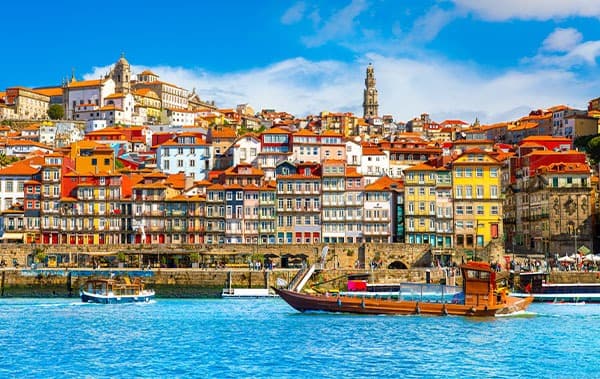
Portugal – Porto to Lisbon Cycling Tour
Upon request (minimum of 8 participants)
Days 1–10: Porto, Aveiro, Figueira de Foz, Coimbra, Tomar, Nazare, Peniche, Lisbon
The Atlantic coast from Porto to Ericeira with a loop inland to Coimbra, Tomar, Fátima and Batalha, finishing with a transfer to Lisbon.
- Length
- 10 days
- Difficulty
- Demanding
- Price
- $3,740 USD or $5,310 AUD
Where the Riding Is
The national-scale route is EuroVelo 1, the Atlantic Coast Route, which follows the entire coast of Portugal. Its southern part crosses the Algarve from the Spanish border to Sagres, more than 200 km (about 125 miles) of coastline.
Between Porto and Lisbon, the coast is a string of lagoons, long beaches and fishing ports: Aveiro and its canals, Figueira da Foz, Nazaré, Peniche and Ericeira. A short way inland is a line of historic towns that carry three World Heritage listings: the University of Coimbra, the Convent of Christ in Tomar and the Monastery of Batalha. Porto's own historic center is a fourth.
Our route uses both. It stays on the coast for the first two riding days, turns inland up the Mondego to Coimbra, crosses the hills to Tomar, and comes back to the sea at Nazaré by way of Fátima and Batalha.
When to Go
The Atlantic keeps the coast temperate, and the north is cooler and wetter than the south. The national weather service, IPMA, publishes climate normals for 1991 to 2020. At Porto's Pedras Rubras station the average daily high is 20.3 °C (68.5 °F) in May, 24.3 °C (75.7 °F) in July and 23.5 °C (74.3 °F) in September. In Lisbon the same months average 23.1 °C (73.6 °F), 28.2 °C (82.8 °F) and 26.6 °C (79.9 °F). Coimbra, away from the sea, is the warmest of the three in summer at 29.1 °C (84.4 °F) in August.
Rain sets the limits of the season. Porto averages 16.6 mm in July and 148.9 mm in October. Lisbon averages 2.6 mm in July and 110.6 mm in October. That makes May to September the dry months. October is markedly wetter, above all in the north.
Wind is the other factor. IPMA describes the nortada as a north or north-west wind on the west coast of mainland Portugal that peaks in the afternoon and is characteristic of the warmest months, from May to September. A rider heading south from Porto has it mostly behind them, which is a good reason to ride this coast from north to south.
Roads, Rules and Cycle Paths
Portugal's Highway Code, the Código da Estrada, gives cyclists some specific protections. A driver must keep a lateral distance of at least 1.5 m (about 5 feet) from a bicycle traveling on the same carriageway, and must slow down when overtaking one. Cyclists may ride two abreast, but not on roads with reduced visibility or in heavy traffic, never more than two, and only if it causes no danger or obstruction. They may also use the shoulder, provided they do not endanger pedestrians on it.
The Code's helmet article applies to riders of mopeds, motorcycles, tricycles and quadricycles. Ordinary bicycles are not included in it. When lights are compulsory, a bicycle may only be ridden with them, and a bicycle whose lights have failed must be walked. The Code prohibits driving under the influence of alcohol, defined as 0.5 grams per liter of blood or more, and prohibits the use of headphones and the handling of phones while a vehicle is moving.
On trains, CP carries bicycles free of charge on its urban services in Lisbon, Porto and Coimbra, while on Alfa Pendular trains a bike must be folded or dismantled and carried as hand luggage. Check the current rules before you travel. This is a summary, not legal advice.
What Riding Here With Us Looks Like
The tour has seven riding days and a day off in Coimbra. The stages run from 64 km (40 miles) to 88 km (55 miles). It is graded Demanding. The difficulty note asks that you be able to ride 70 to 95 km (45 to 60 miles) comfortably on flat or rolling terrain, and says most of the hilly riding comes on days 4, 6 and 7. Most roads and bike paths are paved, with several unpaved sections.
The price includes nine nights in 3-star and 4-star hotels and pensions, breakfast every morning and four dinners, a boat tour in Aveiro, a walking tour in Coimbra, a guide and ride leader, cue sheets and GPS files, and van support with luggage transport. The last stage ends in Ericeira, and a shuttle takes the group into Lisbon.
Get to Know Portugal
Where the riding is, when to go, and what you will eat and see on the way. These were written for our Porto to Lisbon route, which rides through Portugal.
Plan Your Portugal Ride
What the trip costs and involves: where you stay, the bike, what to pack, the roads and the rules, and how fit you need to be. These were written for our Porto to Lisbon route, which rides through Portugal.
- ItineraryPorto to Lisbon by Bike: The Itinerary, Stage by Stage
- CostsCost Breakdown: How Much Does a Porto to Lisbon Cycling Tour Cost?
- Where to stayAccommodation Options Along the Porto to Lisbon Cycling Route
- Bike rentalBike Rentals and Support for Porto to Lisbon Cycling Tours
- Packing listWhat to Pack for Your Porto to Lisbon Bike Tour: Essential Gear & Tips
- SafetySafety Tips and Road Conditions for Cycling from Porto to Lisbon
- TrainingHow to Train for a Multi-Day Cycling Tour in Portugal
Choose Your Tour and Book It
Once Portugal is on your list, these are the pages that settle the rest: how a guided tour compares with going alone, what our price covers, how hard the riding is, and how to reserve a place.
What the price includes
Lodging, breakfasts, guides, van support and luggage transport, and where the list stops.
Difficulty levels
How we grade Easy, Moderate and Demanding, and how to tell which you are ready for.
Bike rentals
The bikes we rent, what comes fitted to them, and bringing your own instead.
How reservations work
Confirm there is space, complete one registration form per rider, then send your deposit.
Private departures
Any of our tours can run on other dates for your own group, with the itinerary tailored to it.
What riders say
Testimonials from riders who have been on tour with us.
Ready to ride Portugal?
Register for a scheduled departure, or ask us about dates for your own group.

Stay Updated
Subscribe to be updated on our latest news.