
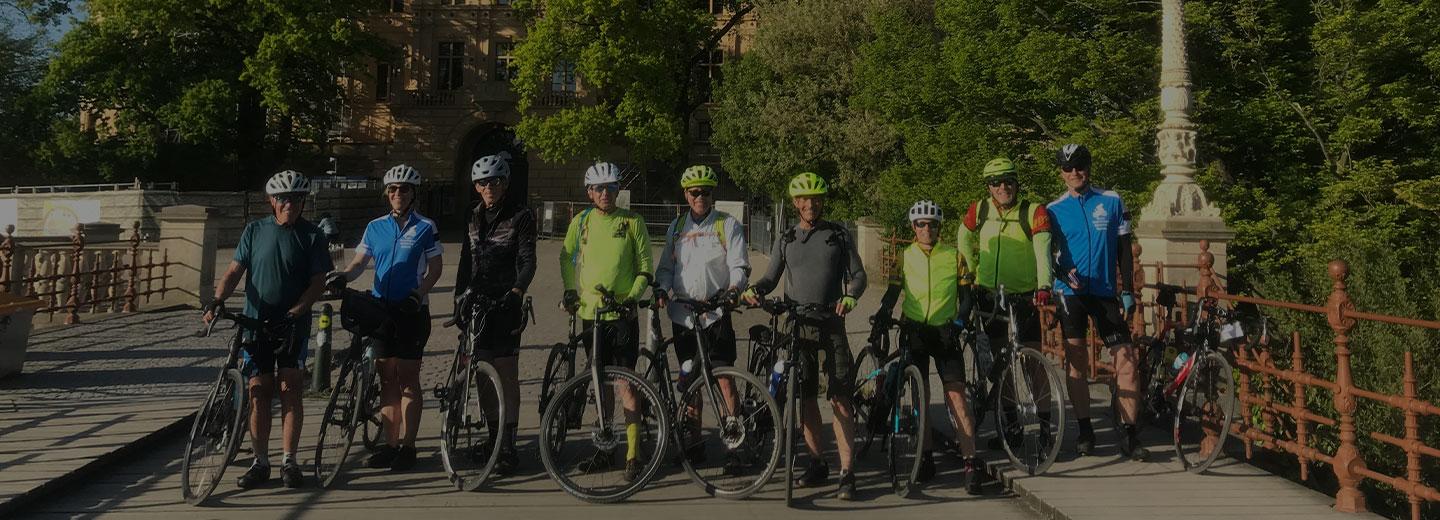
Cycling in France
A Rider’s Guide to France
France takes up eight of the twelve days of our London to Paris tour. We roll off the overnight ferry at Saint-Malo in Brittany, ride to Mont Saint-Michel, cross Normandy by way of the D-Day beaches, Lisieux and Rouen, and follow the Seine valley toward Paris.
The articles on this site already cover that route day by day. This page is about the country around it: how France organizes its long-distance cycle routes, what French law asks of a cyclist that English law does not, and what the weather records say about Normandy in the riding months.
The short version for a rider coming off the boat: you are now on the right-hand side of the road, the currency is the euro, and three items the Highway Code left optional, a bell, a helmet for children and a reflective vest outside towns after dark, are written into French rules.
France at a Glance
- Our tours here
- London to Paris Cycling Tour
- Best months to ride
- May to September
- Terrain on our route
- Rolling to moderately hilly, 48 to 103 km (30 to 64 miles) a day
- Currency
- Euro
- Helmet law
- Required under age 12; recommended for everyone else
- Alcohol limit
- 0.5 g per liter of blood, cyclists included
- Emergency number
- 112
Our Guided Tour in France
One of our tours rides France. Dates, price and difficulty below come straight from the tour page.
London to Paris Cycling Tour
May 23 – June 3, 2027
Days 5–12: Saint Malo, Saint-Michel (two nights), Saint-Lô, Omaha Beach, Lisieux, Rouen, Paris
Brittany's coast to Mont Saint-Michel, then Normandy by way of Utah and Omaha beaches, Lisieux and Rouen, and the Seine valley to Paris.
- Length
- 12 Days
- Difficulty
- Moderate
- Price
- $4,920 USD or $6,980 AUD
Where the Riding Is
France plans its long-distance cycling through a national scheme of véloroutes. The body that coordinates it, Réseau vélo et marche, puts the scheme at 26,100 km (about 16,200 miles), of which 4,570 km are still to be built by 2030. Ten EuroVelo routes are part of it. A voie verte, or greenway, is one kind of infrastructure those routes use: the road-safety authority defines it as a zone fully independent of the rest of the road network, used first of all by non-motorized vehicles, personal electric vehicles such as scooters, and pedestrians.
Four named routes cross the country our tour rides through. La Vélomaritime, the French section of EuroVelo 4, runs nearly 1,500 km (930 miles) from Roscoff in Brittany to Dunkirk, by way of Saint-Malo, the bay of Mont-Saint-Michel and the D-Day landing beaches. La Véloscénie is a 450 km (280 mile) signed route between Paris and Mont-Saint-Michel. La Seine à Vélo links Paris and the sea through Giverny, Les Andelys and Rouen. The Avenue Verte is the signed London to Paris route of 415 or 470 km (260 or 290 miles), depending on the variant, by the Newhaven to Dieppe ferry.
Our route is not any one of these. It shares their territory, the Channel coast from Saint-Malo to the landing beaches and then the Seine valley above Rouen, but it is our own line on small roads, and it puts Utah Beach, Omaha Beach and Lisieux on the way.
When to Go
The Météo-France station at Caen-Carpiquet sits in the middle of our Normandy days. Its 1991 to 2020 averages give a daily maximum of 17.4°C (63°F) in May, 20.5°C (69°F) in June, 22.9°C (73°F) in July, 23.2°C (74°F) in August and 20.4°C (69°F) in September. Average minimums in May are 8.5°C (47°F), so the first hour out of the hotel wants a layer.
Normandy is green for a reason. The same station counts eight to ten days a month with at least 1 mm of rain from May to September, and between 51 and 60 mm of rain in each of those months. Hot days exist but are few: an average of under four days a year reach 30°C (86°F). The current departure dates are on the tour page.
Roads, Rules and Cycle Paths
These points come from the French road-safety authority, Sécurité routière, and from the government's Service-Public site. A helmet is compulsory for children under 12, whether riding or carried, and strongly recommended for everyone older. A bell is required equipment, as are front and rear brakes and reflectors front, rear, on the wheels and on the pedals. A front light and a red rear light are required at night and whenever visibility is poor by day. In those same conditions, outside built-up areas, the rider and any passenger must wear a retro-reflective vest.
The standard limit for drivers applies on a bicycle too: riding with more than 0.5 g of alcohol per liter of blood is an offense. Headphones and earbuds are not allowed, and neither is a phone held in the hand; the authority's 2022 leaflet lists a fine of 135 euros for either. Riding on the sidewalk is permitted only for children under 8.
Groups may ride two abreast, and must move into single file at night, when a vehicle is overtaking, or when the road is narrow. Drivers passing a cyclist must leave 1 meter in town and 1.5 meters outside it. Cycle facilities come with two kinds of sign, one marking a lane or path as compulsory and one marking it as recommended, so the sign, not the paint, tells you whether you may stay on the road. At some traffic lights a small sign lets cyclists pass a red light in the direction of its arrow after yielding. Rules change, so check the Sécurité routière website before you travel; this is a summary, not legal advice.
What Riding Here With Us Looks Like
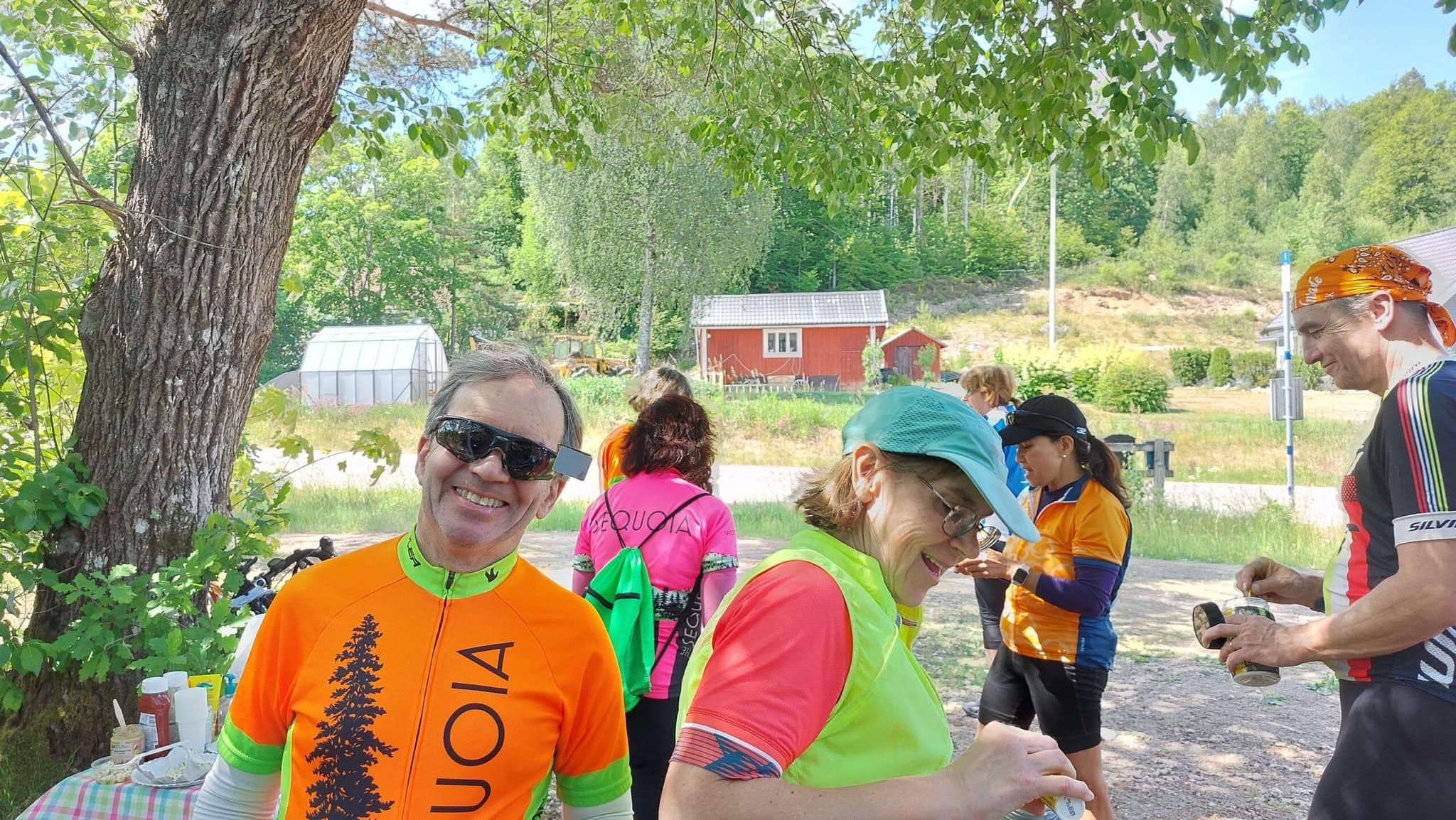
The French leg starts gently and builds. Day 5 is 48 km (30 miles) from Saint Malo to our hotel near Mont Saint-Michel, and Day 6 is a day off there, with the visit to the Mont after breakfast by bike or in the van. Then come five riding days in a row: 90 km (56 miles) to Saint-Lô, 94 km (58 miles) to Utah Beach and Omaha Beach, 93 km (58 miles) to Lisieux, 85 km (53 miles) to Rouen and 103 km (64 miles) toward Paris.
That run of five is what the moderate grade is really describing. The tour asks for 70 to 95 km (45 to 60 mile) days on rolling to moderately hilly terrain, and the last day is longer than that. On Day 11 we get off the bikes on the outskirts of Paris and take a shuttle to the hotel in the city center, so nobody rides into the capital's traffic.
Entry to Mont Saint-Michel and the visit to the Utah and Omaha beaches are included, and there is an optional cheese and wine tasting in Rouen. As everywhere on our tours, the van carries the luggage, stops with snacks, and takes riders who want part of a day off.
Get to Know France
Where the riding is, when to go, and what you will eat and see on the way. These were written for our London to Paris route, which rides through France.
Plan Your France Ride
What the trip costs and involves: where you stay, the bike, what to pack, the roads and the rules, and how fit you need to be. These were written for our London to Paris route, which rides through France.
- ItineraryDetailed Itinerary for a Multi-Day London to Paris Bike Tour
- CostsBudgeting Your London to Paris Bike Tour: Costs and Money-Saving Tips
- Where to stayWhere to Stay on the London to Paris Bike Route: Accommodation Guide
- Bike rentalBike Rentals and Guided Tours for London to Paris Cycling Trips
- Packing listWhat to Pack for Your London to Paris Cycling Tour: Essential Gear & Tips
- SafetyCycling Safety and Road Conditions from London to Paris
- LogisticsHow to Cross the English Channel on a London to Paris Bike Tour
Choose Your Tour and Book It
Once France is on your list, these are the pages that settle the rest: how a guided tour compares with going alone, what our price covers, how hard the riding is, and how to reserve a place.
What the price includes
Lodging, breakfasts, guides, van support and luggage transport, and where the list stops.
Difficulty levels
How we grade Easy, Moderate and Demanding, and how to tell which you are ready for.
Bike rentals
The bikes we rent, what comes fitted to them, and bringing your own instead.
How reservations work
Confirm there is space, complete one registration form per rider, then send your deposit.
Private departures
Any of our tours can run on other dates for your own group, with the itinerary tailored to it.
What riders say
Testimonials from riders who have been on tour with us.
Ready to ride France?
Register for a scheduled departure, or ask us about dates for your own group.

Stay Updated
Subscribe to be updated on our latest news.